I’m going to do something new for me on this blog. Instead of blogging about a movie or a play or a miniseries that’s based on a book or a play or another movie, I’m blogging about books that are based on other books. That means there aren’t going to be many images in this post. Hopefully, my words will be engaging by themselves. We’ll see.
Robin McKinley is a wonderful writer, but I wouldn’t necessarily call her a great storyteller. Or maybe it’s the other way around. She does a great job telling her plots. It’s the plots themselves with which I take issue. In this post, I’m going to look at all her fairy tale adaptations, as well as The Outlaws of Sherwood, which is an adaptation of a popular legend, in the order they were published. [1]Why am I including The Outlaws of Sherwood? Because I feel like it. We’ll see what that tells us about McKinley’s evolution as an artist.
Beauty: A Retelling of the Story of Beauty & the Beast (1978)
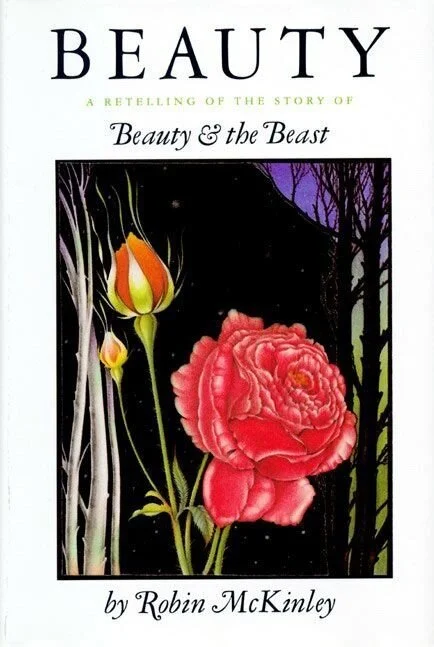
The main criticism that I’ve read of this book-not that there’s much criticism of it out there-is that it just retells the fairy tale of Beauty and the Beast in novel form without putting any twist on it. That doesn’t bother me at all. I believe the original fairy tale is a strong enough story that it doesn’t need any big twist. And even if it did, McKinley’s telling isn’t entirely without original ideas. For one thing, the titular character’s name becomes an ironic one as she starts the book, in her own opinion anyway, as gawky and awkward. The nickname isn’t intended as sarcasm though. She got it when…you know what? I’m not going to spoil the story behind that. It’s entertaining and it appears right at the beginning of the first chapter, so it’s not like you need to read far to learn it.
Another fairly major twist on the classic fairy tale is that Beauty’s older sisters, Grace and Hope, aren’t negative characters. They actually have a very loving relationship with her and even get appealing love interests of their own. [2]Technically, the sisters had love interests in the fairy tale by Jeanne Marie Leprince de Beaumont, but they were negative foils meant to make the Beast look better. When these sisters ask their father to bring them back riches and finery from the city, they’re clearly joking. And when Beauty begs the Beast to let her return to her family in this version, it’s because she wants to help her sister, not her father. As a matter of fact, every character we meet in the book is likeable. (When Beauty’s merchant father loses his money at the beginning, we’re told that some of his creditors would forgive his debts for friendship’s sake, but he refuses out of honor.) Beauty is a lovely, cozy, comfort read. I’m sorry that praise sounds condescending rather than hearty. This really is an excellent book. It’s full of likeable characters, the romance between Beauty and the Beast is compelling and best of all is the enchanted castle, which practically becomes a character in itself. When I read the book as a fantasy-loving kid, my inclination was to skip the early chapters about Beauty’s family’s descent into poverty and move to the countryside and go straight to the wonders of the castle. As an adult, I appreciate what a good job McKinley does of writing those early realistic parts and slowly introducing the ominous threat of magic. Beautifully written, sometimes dryly humorous, only occasionally eerie, but mostly warm and cozy, this Beauty shines.
The Door in the Hedge (1981)
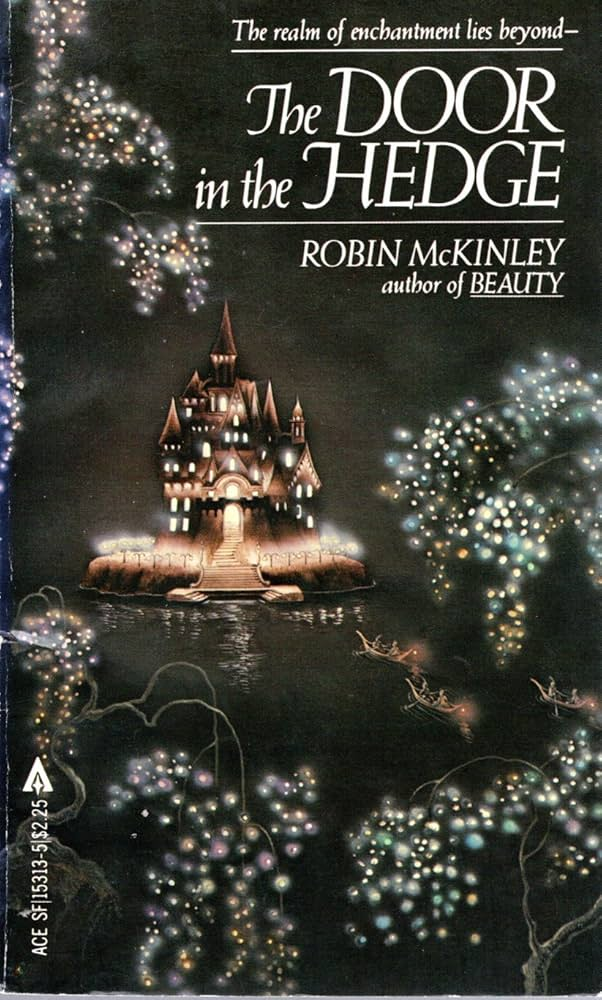
This short story collection features two original fairy tales and two reimaginings of old ones. In them, McKinley’s goal seems to be to take stories that weren’t very romantic as told by the Brothers Grimm and make them so. This is especially true of the first one, The Princess and the Frog which is, of course, based on The Frog Prince. [3]Or The Frog King if you want to translate the original German literally. In McKinley’s version, it’s not a golden ball that Princess Rana accidentally drops in a pool, but a necklace gifted to her by her unwelcome suitor, the evil Prince Aliyander. (I love McKinley’s fantasy names.) On the one hand, she’s relieved to be rid of it since it was bewitched to enslave her. On the other, she’s terrified of what Aliyander will do if he doesn’t see her wearing it. So when a talking frog offers to retrieve the necklace for her in return for a small favor, she doesn’t ask questions. The Princess and the Frog is the shortest story in The Door in the Hedge but it’s a very gripping read. I feel it would be even better if there were an explanation for why the pool’s water has the effect on Aliyander’s magic that it does. The lack of an explanation though is pretty true to the spirit of the Brothers Grimm. The story operates more on emotional logic than on logical logic. Take it or leave it.
The Twelve Dancing Princesses sticks closer to its source material. The main difference is that the princesses aren’t just sneaking off to dance every night for fun. They’re under an evil spell and the beautiful subterranean world to which they go is much more sinister and downright demonic than it is in Grimm. [4]The anime series Grimm’s Fairy Tale Classics does something similar with the story. This makes both the princesses and the soldier, who uncovers their secret, much more sympathetic characters and the prospect of the soldier marrying the eldest princess much more appealing. [5]My favorite version of the fairy tale, by the way, isn’t the Grimms’ but the one by Charles Deulin. I guess Andrew Lang agreed with me since that’s the version he included in his … Continue reading McKinley’s Twelve Dancing Princesses is a superb piece of writing. Her descriptive powers make the everyday castle just as magical as the underground one. I do feel like the story could have used an added complication in the middle though to make it more suspenseful. There’s an indication that the soldier might be corrupted by the magic of the underground world himself that could have been expanded. But, again, the lack of a complication is pretty true to Grimms’ fairy tales. [6]If you’d like my reviews of the two original stories, the first one, The Stolen Princess, begins wonderfully. McKinley does a great job getting you invested in the characters in only a short … Continue reading
The Outlaws of Sherwood (1988)
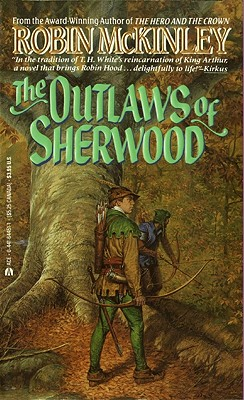
Robin Longbow isn’t nearly the great archer that his deceased forester father was, but when a couple of local bullies force him into a private archery contest one day, he wins by a lucky shot. The bullies aren’t happy and Robin accidentally kills one of them in self-defense. His friends, Much, a fellow yeoman, and Marian, a half-Saxon noblewoman, help hide him. They suggest that his story could be a rallying point for the oppressed Saxons and eventually, Robin is leading a band of heroic outlaws in Sherwood Forest.
The Outlaws of Sherwood is what TVTropes.org would call a Decon-Recon Switch of the Robin Hood mythos. When Much and Marian first make their proposal to Robin, he points out all the impracticalities and inconveniences that the more romantic Robin Hood stories ignore. “Do you understand what the isolation of living in Sherwood would mean? It would be a short life, for one thing; we would only be able to kill the king’s deer to feed ourselves for as long as our arrows held out, for we would not be able to buy steel and twine to make more. Even if we knocked a travelling fletcher on his head for his supplies, where could we leave the wood need for shafts to season, when we had not even a place to sleep dry?” He goes on like that for a couple of paragraphs. When Robin and Little John have their famous staff fight over who gets to cross a bridge, Robin is disgusted by his own pettiness. When the sheriff of Nottingham tries to entrap him by holding an archery contest with a golden arrow for a prize, Robin’s response is “And what would we do with a golden arrow?” Yet these outlaws ultimately prove to be as heroic and competent as their more romantically drawn counterparts (or nearly so anyway.) This balance between being a deconstruction and a reconstruction leads to genuine suspense as we’re not sure whether King Richard is going to pardon our heroes or punish them.
What keeps all the “demythification” from being simply boring is that the characterizations are so engaging. Of all the books discussed in this blog post, this is probably the funniest, largely thanks to Much’s wisecracking. It’s a good thing the humor and the characterizations are so good because the structure of the story isn’t the best. The first half is mostly character introductions-the book includes pretty much every famous figure from the legend and at least one major original character-with very little action. In the second half, there’s suddenly so much action and violence that it’s a little jarring, as if the book has turned into something totally different. When I first read The Outlaws of Sherwood, I found it worth a read but wasn’t sure if it would be worth more than that. Having given it a second read in preparation for this blog post, I’m glad I did so. It wouldn’t surprise me if someday I read it a third time.
Deerskin (1993)
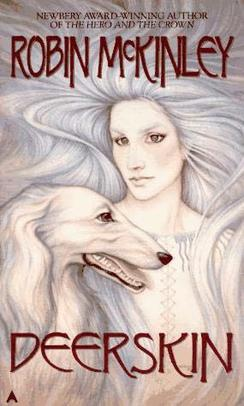
The other books discussed in this blog post are Young Adult or could pass as Young Adult. Deerskin is for adults and I mean Adults. Seriously, the subject matter is so sensitive that I advise readers faint of stomach to just skip to the next section. It’s a complete 180 from the coziness of Beauty.
You see, Deerskin takes its inspiration from Donkeyskin by Charles Perrault. The premise of Donkeyskin is that a crazy king, grieving for the death of his beloved wife, realizes his daughter looks like her and lusts after the girl. To avoid being forced to marry her father, the princess flees the court, disguised in a magical donkey skin. It’s less gross to read than that description makes it sound. After all, it’s a fairy tale so the king’s sexual obsession isn’t depicted in detail. After Donkeyskin, as she’s called, runs away, the story focuses on her romance with a young prince and becomes a variation of Cinderella. [7]Jim Henson’s The Storyteller adapted a variant of the story in an episode, but their king didn’t want to marry his daughter any more than she wanted to marry him. The characters were … Continue reading McKinley, however, goes for the worst possible scenario. Her king beats and rapes his daughter, Lissar, before she manages to escape. Mercifully, this act isn’t described in detail. McKinley just writes that the king “did to her what he had come to do.” She doesn’t shy away from the ensuing pain and trauma though. Not at first anyway. Eventually, a benevolent goddess-like figure known as Moonwoman, loosely corresponding to the fairy godmother from Donkeyskin, not only gives Lissar her disguise but magically lets her forget her trauma until she’s strong enough to do so.
I’m surprised at myself for reading this book, considering its subject matter. It’s the kind of thing I would read because it was a college assignment rather than of my own free will. Generally, I restrict reading about incestuous rape to Greek mythology books and the Bible. The decision was due to a number of factors. (a) I had a sudden hankering for books by Robin McKinley that I hadn’t read before, (b) I was intrigued by her choice of a less famous fairy tale, (c) I wanted to write this blog post and (d) I was curious to see if her beautiful writing could make the intolerable tolerable. Well…it kind of did. I was sucked in initially by her depiction of the king’s creepy obsession with his beautiful queen, the queen’s creepy obsession with herself and their daughter’s lonely, neglected childhood. As sickening as Lissar’s tragedy was, I was too invested in her to stop reading, which I wouldn’t necessarily say about the similarly miserable stories I sometimes had to read for college. While a book like this can never have a completely happy ending, McKinley manages a cautiously hopeful one. I don’t regret reading Deerskin but I’m also glad to be done with it.
Rose Daughter (1997)
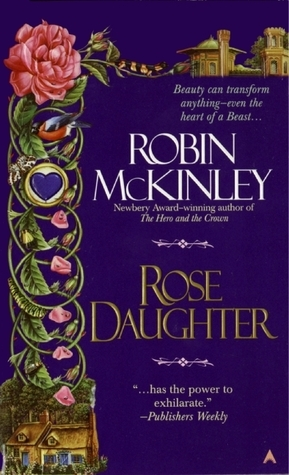
In this book, McKinley returns to her favorite fairy tale, Beauty and the Beast, with a new retelling. [8]Her books, Sunshine and Chalice arguably also use the Beauty and the Beast motif. Rose Daughter is clearly the work of a more mature artist than Beauty. This one paragraph where Beauty sees the Beast’s face for the first is more powerful than anything in the earlier book.
Had she had the opportunity to choose, she would still have chosen to look immediately into the Beast’s face upon meeting, to have the worst borne and past at once. But the worst borne is not necessarily past and over with thereby. The worst of fighting a dragon is being caught in its fire but you do not survive dragon encounters by commanding your muscles to withstand dragon fire, because you and they cannot. You survive by avoiding being burnt.
Beauty’s sisters in this version, the brash Lionheart and the somewhat acerbic Jeweltongue, are not as immediately lovable as Grace and Hope, perhaps because they’re less domestic, but they also have more distinct personalities and emerge as more interesting. Her father is also a less uncomplicatedly positive figure than his counterpart in Beauty. After his beloved wife’s death, he has all the magicians driven from the city because he blames them for not warning her ahead of time about her fatal accident. When he loses all his money and the family has to leave the city themselves, he sinks into listlessness and his daughters have to take all the initiative. Again, this makes him less immediately likeable but more interesting. Beauty herself is quite different from the heroine of McKinley’s earlier take on Beauty and the Beast. Both Beauties are introverts who see themselves as being in the shadows of their older sisters. But the Beauty of Rose Daughter is quiet and lacks the other Beauty’s bluntness and academic ambitions. She has no misgivings about her looks but feels she lacks any gift besides those looks-until her family moves to a cottage in the country, mysteriously left to them, and she discovers a seemingly magical talent for growing roses. When her father’s life is on the line though, this Beauty proves to be just as determined as McKinley’s earlier, more obviously stubborn version.
For most of Rose Daughter, I was ready to declare it superior to Beauty. But I can’t do that. For one thing, this book’s enchanted castle, while perfectly magical on its own terms, just isn’t as interesting as the one in Beauty. A much bigger reason is the ending. Major Spoilers Ahoy! Beauty is given a choice. She may return the Beast to his human state and be married to a wealthy, powerful, handsome man or she may keep him as he is, and they can both live a humble life together in the village where she was happiest. When she hears that her name and her husband’s will “be spoken in fear and in dread” if she makes the former choice, Beauty chooses the latter. The Beast’s only regret is that he won’t be as handsome as he was for Beauty’s sake. But she says, “I love my Beast and I would miss him very much if he went away from me and left me with some handsome stranger.” I can’t avoid the implication that she’s going to have sex with some kind of animal. Eeeewwwww! And, unlike the disturbing parts of Deerskin which were supposed to be disturbing, this is meant to be heartwarming. It sours me on the whole book. Is there anything more frustrating than a great book with a terrible ending? [9]To be fair, the physical descriptions of the Beast are a bit vague, apart from him being big and hairy. But we’re told he can see in the dark, doesn’t mind the weather and can “walk … Continue reading
Spindle’s End (2000)
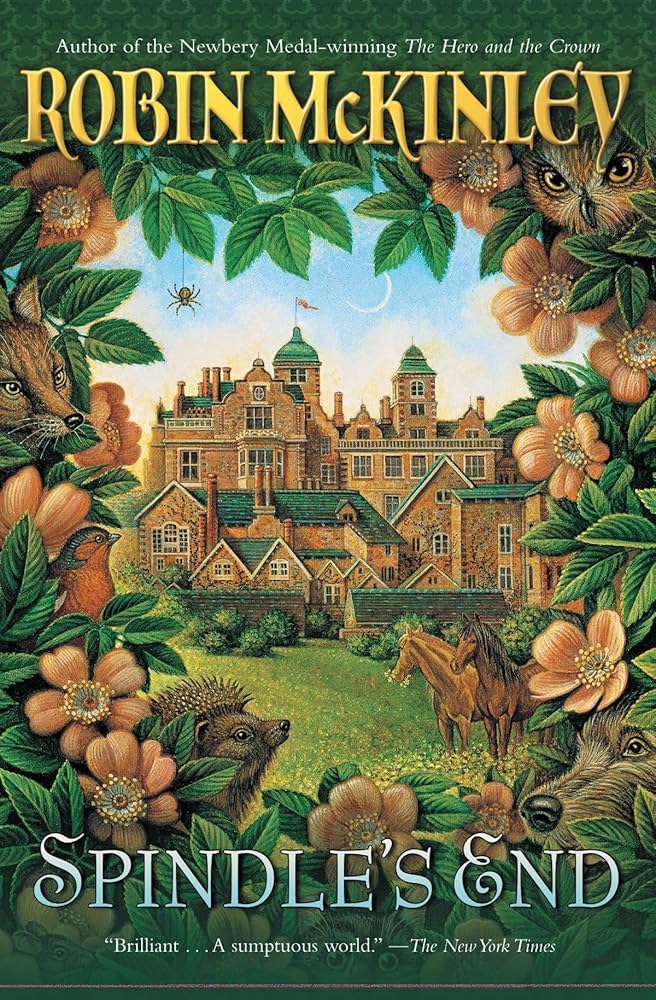
To an unusual extent for McKinley, this reimagining of Sleeping Beauty owes something to Disney. (No shame, the 1959 animated movie is a favorite of mine.) On her name-day, an infant princess is cursed by the evil fairy Pernicia to prick her finger on a spindle sometime before or on her twenty-first birthday and fall into a poisoned sleep forever. For her safety, the baby is secretly sent to live with nicer though not as powerful fairies in the obscure hamlet of Foggy Bottom. Due to a combination of a gift one of the fairies gave her and drinking the milk of various animals on her journey to Foggy Bottom, Rosie [10]short for Casta Albinia Allegra Dove Minerva Fidelia Aletta Blythe Domina Delicia Aurelia Grace Isabel Griselda Gwyneth Pearl Ruby Coral Lily Iris Briar-Rose grows up with the ability to communicate with animals. As the deadline for the curse looms, her allies come up with a plan to trick Pernicia. [11]Both Spindle’s End and Deerskin, by the way, take place in the same universe as McKinley’s other books, The Blue Sword and The Hero and the Crown.
I really want to like this book. It has the most sparkling opening of any of the tomes discussed in this blog post.
The magic in that country was so thick and tenacious that it settled over the land like chalk-dust and over floors and shelves like slightly sticky plaster dust. (Housecleaners in that country earned unusually good wages.) If you lived in that country, you had to de-scale your kettle of its encrustation of magic at least once a week, because if you didn’t, you might find yourself pouring hissing snakes or pond slime into your teapot instead of water. (It didn’t have to be anything scary or unpleasant, like snakes or slime, especially in a cheerful household—magic tended to reflect the atmosphere of the place in which it found itself—but if you want a cup of tea, a cup of lavender-and-gold pansies or ivory thimbles is unsatisfactory…)
It’s that combination of the magical and the practical that I love about McKinley. [12]I was also amused by how when describing local tall tales in the book’s world, she lists “large silver carriages with long stiff wings that flew through the air like birds” and … Continue reading Spindle’s End also has the most fun villain of any of her fairy tale retellings though the story’s structure sadly requires her to be offstage for most of it.
But there’s no getting around the fact that the book drags. The middle section is mostly about Rosie growing up in Foggy Bottom which might have worked if she were a better character. But the only idea for her personality seems to have been that it be the opposite of a stereotypical fairy tale princess. Not that that can’t work. Beauty of Beauty was also different from a stereotypical fairy tale princess, being blunt, unsentimental, academically minded and self-deprecating without being particularly angsty about it. [13]Beauty of Rose Daughter was closer to the stereotypical fairy tale princess though she had an un-princess-like penchant for getting her hands dirty gardening. But with Rosie, this translates into her being defined by not being things (mainly not being girly) rather than by being anything. If she’s likeable, that’s all she is and sometimes she’s not even that. As a little girl, we’re told that when adults called her pretty, she’d say, “I am not pretty. I am intelligent. And brave.” This gives me the impression that she was incredibly self-righteous at an incredibly young age. I also got tired of the running joke about her hating her golden curls. It’s funny at first when a character is disgusted that her fairy godmothers, who could give her anything on her name-day, give her things like “golden hair, gold as corn-tassels in August” and “eyes as blue as love-in-a-mist or summer sky after rain.” But the book keeps bringing it up to an obsessive extent. Once Rosie learns her true identity, she realizes that her hated hair was given to her by a fairy and she comes across as angrier about that than that a fairy cursed her to sleep forever. It’s just hair! Get over it! There is an interesting idea with Rosie’s friendship with a girl called Peony who’s almost her exact opposite in personality. I find friendships like that interesting but, unlike with Beauty and her sisters [14]This could apply to either Beauty or Rose Daughter., McKinley just tells us they’re friends despite their differences and doesn’t do any of the heavy lifting necessary to actually make us believe in the friendship.
You’d think the book would become more exciting as it reaches the climax, but it doesn’t, mainly because the climax is hard to follow. The following paragraph is chock full of spoilers. Read at your own risk. The good fairies use Peony as a decoy so that she ends up pricking her finger instead of Rosie. But even though she was never cursed, Peony ends up falling asleep anyway for reasons that are not very clearly explained. So does everyone else except for Rosie and another character for reasons are also not very clearly explained. Then Rosie defeats Pernicia by…honestly, I’m not sure how to describe it. I wrote above that the climax of The Princess and the Frog runs on emotional logic rather than logical logic and much the same could be said of the surreal climax of Deerskin but I’m not sure if the climax of Spindle’s End runs on any kind of logic. I even looked at the plot summary on Wikipedia to help me understand it but the person who wrote it seemed at a loss to explain the climax too. (Maybe someone who’s a fan of the book will read this blog post and edit Wikipedia to rectify this.) The ending, in which Rosie and Peony permanently switch places so that Peony becomes the princess and Rosie stays in Foggy Bottom, also rubs me the wrong way. McKinley piles up reasons for this. It’s Peony’s only chance at a loving family, she’s the more princessy of the two girls, Rosie would rather be a horse leech, and the switch allows both girls to end up with their love interests when otherwise class would be a barrier. She piles up so many reasons, I daresay, the resolution is downright predictable. But it bugs me and it’s McKinley’s own fault. In the early parts of the book, she makes me feel sorry for the Queen who is separated from her firstborn child that it angers me that she’s never allowed to get to know her real daughter. For me anyway, Spindle’s End is the weakest of McKinley’s fairy tale-inspired books.
So Which Book is the Best?
I’d have to give that honor to Beauty. I write that with some reluctance since I do think some of McKinley’s later work is more interesting and even more well written. And that’s not faint praise since Beauty, on its own merits, is a beautifully written book. But if Beauty doesn’t reach the high points some of her later works do, it also doesn’t hit their low points. There are no pacing problems, no confusing climax and no problematic resolution. It’s just a great story, well told. What can I say? Sometimes it pays to stick close to your source material.
References
| ↑1 | Why am I including The Outlaws of Sherwood? Because I feel like it. |
|---|---|
| ↑2 | Technically, the sisters had love interests in the fairy tale by Jeanne Marie Leprince de Beaumont, but they were negative foils meant to make the Beast look better. |
| ↑3 | Or The Frog King if you want to translate the original German literally. |
| ↑4 | The anime series Grimm’s Fairy Tale Classics does something similar with the story. |
| ↑5 | My favorite version of the fairy tale, by the way, isn’t the Grimms’ but the one by Charles Deulin. I guess Andrew Lang agreed with me since that’s the version he included in his Red Fairy Book. |
| ↑6 | If you’d like my reviews of the two original stories, the first one, The Stolen Princess, begins wonderfully. McKinley does a great job getting you invested in the characters in only a short space. But the resolution is anticlimactic and leaves you wondering, “why didn’t they just do that a long time ago?” The Hunting of the Hind is arguably anticlimactic too, but the protagonist’s victory is rooted more in their character and for me, that story just might be the highlight of the book. |
| ↑7 | Jim Henson’s The Storyteller adapted a variant of the story in an episode, but their king didn’t want to marry his daughter any more than she wanted to marry him. The characters were forced into an engagement by an ancient law saying that the king must wed the woman who can wear a certain ring. |
| ↑8 | Her books, Sunshine and Chalice arguably also use the Beauty and the Beast motif. |
| ↑9 | To be fair, the physical descriptions of the Beast are a bit vague, apart from him being big and hairy. But we’re told he can see in the dark, doesn’t mind the weather and can “walk as silently as sunlight.” To me, that says animal. |
| ↑10 | short for Casta Albinia Allegra Dove Minerva Fidelia Aletta Blythe Domina Delicia Aurelia Grace Isabel Griselda Gwyneth Pearl Ruby Coral Lily Iris Briar-Rose |
| ↑11 | Both Spindle’s End and Deerskin, by the way, take place in the same universe as McKinley’s other books, The Blue Sword and The Hero and the Crown. |
| ↑12 | I was also amused by how when describing local tall tales in the book’s world, she lists “large silver carriages with long stiff wings that flew through the air like birds” and “long-distance speaking devices involving no magic.” |
| ↑13 | Beauty of Rose Daughter was closer to the stereotypical fairy tale princess though she had an un-princess-like penchant for getting her hands dirty gardening. |
| ↑14 | This could apply to either Beauty or Rose Daughter. |