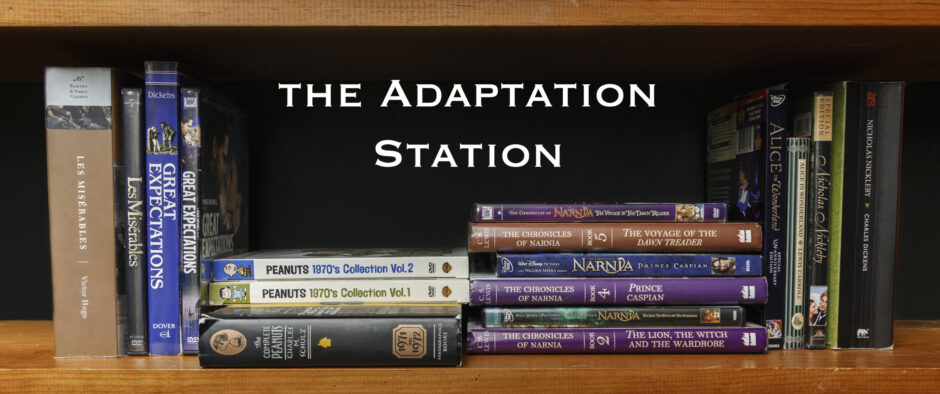
This blog probably isn’t really going away forever. I’ll probably revive it in some form or do some new posts in the future. But I won’t be doing regular posts. This really does feel like the end of an era for me, so I decided to do something special: A recommended reading list of my favorite source materials for the adaptations about which I’ve blogged (in, more or less, the order I’ve blogged about them.)
By the way, the books that didn’t make the list are not one’s I dislike. Really, every adaptation about which I’ve blogged is based on something I consider to be at least OK. Who am I to say that Emma or Charlie and the Chocolate Factory are not great in their own ways? But this list is for what I consider the creme de la creme. It’s also worth noting that these books were written by different authors with different worldviews and I’m including them based on artistry (and, I’ll admit, nostalgia), so don’t assume they all reflect my own worldview.

Les Misérables by Victor Hugo.
This is a book where I’m inclined to recommend you read an abridged version first and then tackle the whole doorstopper if you love the material. However, there’s no abridgment that specifically cuts and retains the same the parts that I would. So I guess what I really recommend is that you get an unabridged copy, but feel free to skim when you feel like it. I warn you though that the final chapter in the Waterloo section has a scene that’s critical to understanding the rest of the plot. For the record, there are some great quotes hidden in Victor’s Hugo infamous digressions in this book anyway.
I’m in love with the poetic style of Charles Wilbour’s English translation. If you insist on one that’s more accessible to modern readers though, Christine Donougher’s seems to be the best and, to its credit, it translates all the songs and poems, which Wilbour’s doesn’t, and handles some of the puns and the slang better.
Les Misérables by Alain Boublil, Claude-Michel Schonberg and Herbert Kretzmer
Since the 2012 movie is technically an adaptation of the both the book and the stage musical, why don’t you read the libretto while you’re at it? It’s available online.
Freaky Friday by Mary Rodgers


Peter and Wendy by J. M. Barrie
Peter Pan by J. M. Barrie
J. M. Barrie wrote Peter Pan as both a stage play and a novel. (The latter was originally titled Peter and Wendy, but most editions today just call themselves Peter Pan.) The adaptations I’ve covered typically use elements of both and they’re both well worth reading, so I’m including both on this list.
If you check out the play’s script, try to get your hands on a copy of Peter Pan and Other Plays which features three others by J. M. Barrie. Two of them, The Admirable Crichton and What Every Woman Knows are just as great. The other, Mary Rose, is fine. Of course, getting The Complete Plays is ideal but difficult.
The Wind in the Willows by Kenneth Grahame


The Complete Fairy Tales of the Brothers Grimm
There are plenty of great English translations of Grimm out there. I personally recommend the one by Jack Zipes, which feels very modern but, in his own words, also “retains an eighteenth-century flavor.”
The Fairy Tales of Charles Perrault
Many of Perrault’s tales, such as Cinderella, Sleeping Beauty and Little Red Riding Hood, have counterparts in the collection of Brothers Grimm. In some ways, his versions are more fun. In other ways, they’re less fun. Perrault includes more humorous touches in otherwise serious stories, such as Sleeping Beauty’s prince refraining from mentioning that “she was dressed a little like his grandmother.” But they’re also less fast-paced and zippy. Nevertheless, both had a huge impact on our idea of a fairy tale.
I recommend the recent English translation by Alex Lubertozzi, Tales of Times Past: The Fairy Tales of Charles Perrault.


The Life and Adventures of Nicholas Nickleby by Charles Dickens
I’ll admit that the beginning of this novel is rather slow paced. You can easily skip the section from Chapter One about the United Metropolitan Improved Hot Muffin and Crumpet Baking and Punctual Delivery Company. And the stories of The Five Sisters of York and The Baron of Grogzwig in Chapter Six aren’t really necessary either, though they’re well written. But if you can handle the longer and more digressive Les Misérables, this should be a snap. Once the main characters are established, it becomes, for me, the most fun of any of Dickens’s books.
The Mary Poppins books by P. L. Travers


The Personal History, Experiences and Observations of David Copperfield by Charles Dickens
Great Expectations by Charles Dickens


Peanuts by Charles M. Schulz
Fantagraphics has released the entire long running comic strip in a series of books. Or you could read the whole thing online at the Peanuts Wiki.
A Christmas Carol in Prose by Charles Dickens


Oliver Twist or The Parish Boy’s Progress by Charles Dickens
The Chronicles of Narnia by C. S. Lewis
Nowadays, these books are numbered in, more or less, the order the stories take place with The Magician’s Nephew being listed as No. 1 and The Lion, the Witch and the Wardrobe as No. 2. The reasoning behind this was the author saying he thought it made more sense to read them in this order rather than the one in which they were published. However, the fan consensus, with which I heartily agree, is that it’s better to experience them in publication order or at least read The Lion, the Witch and the Wardrobe before The Magician’s Nephew. The latter really works best as a prequel.


The Miss Bianca books by Margery Sharp
OK, these books aren’t quite as great as the others on this list, not as consistently great anyway. Around the fourth or fifth books, the plots start to get gradually dumber and less satisfying. But at their best, they’re so charming and they’re so little known, that I had to give them a shoutout here. (I would have done it when I made my list of obscurities, but I hadn’t blogged about the Disney adaptation then.)
The Best Christmas Pageant Ever by Babara Robinson
Robinson wrote two companion novellas to this one, The Best School Year Ever and The Best Halloween Ever. Neither is as interesting as The Best Christmas Pageant, but both are fun.


Cyrano de Bergerac by Edmond Rostand
As far as English translations go, I recommend the one by Brian Hooker or nothing. It’s possible some others are closer to Edmond Rostand’s intent but if so, Hooker must have improved upon Rostand.
The God Beneath the Sea by Leon Garfield and Edward Blishen
OK, so I haven’t blogged about adaptations of this book or the following two, but I mentioned them in my post about posts I didn’t do and they’re awesome.


The Golden Shadow by Leon Garfield and Edward Blishen
Till We Have Faces: A Myth Retold by C. S. Lewis


The Winnie-the-Pooh books by A. A. Milne
The Tale of Despereaux by Kate DiCamillo


Flora & Ulysses: The Illuminated Adventures by Kate DiCamillo
The Alice books by Lewis Carroll
Nowadays I don’t reread these as often as I did when I was a kid. But I feel like I have to include them because otherwise I’d be implying that Peter Pan and Winnie-the-Pooh are better than Alice’s Adventures in Wonderland and I am not prepared to make that statement.

Well, there you go. That should be enough reading material to keep someone busy for a long time. I see that most of the books on this list for kids are fantasies of some sort and most of the books for adults are melodramas of some sort. My friends probably could have predicted that.
Recently, I watched the 1946 adaptation of “Great Expectations”, which was directed by David Lean. I thought it was a pretty good adaptation, but also flawed. And I fear it might be overrated. There are two aspects of the film that had attracted my attentions. One, I thought the film’s cinematography was absolutely beautiful. Outstanding. And two, I hated the ending. I’m not a fan of Pip reuniting with Estella, but I found this particular ending rather silly and off-putting.