The Many Adventures of Winnie the Pooh (1977) is actually a compilation of three previously released animated featurettes (e.g. twenty-five-minute length cartoons that would originally appear before full length movies in theaters) with some (entertaining) bridging material and an epilogue added.[1]If it sounds like I’m criticizing this thing for being a cash grab, I’m not. There’s something to be said for fans being able to watch all three featurettes together. When the first of these featurettes was released, it got terrible reviews from English critics who considered it a dreadful adaptation of its source material, A. A. Milne’s beloved children’s stories. They accused it of being too loud and cartoony, lacking the source material’s gentleness, and too Americanized, lacking its dry, quintessentially English humor. Time has been kind to The Many Adventures though. Most of the modern reviews I’ve read describe it as a good, even great, adaptation of the Pooh stories, especially considering the Walt Disney studio is famous for making inaccurate adaptations. That seems to be the consensus now.[2]It should be noted though that those reviews weren’t generally from English critics. If there’s a grudge held against Disney’s Pooh these days, it’s not so much that it’s regarded as a bad adaptation itself. It’s that it led to multitudinous spinoff movies, shows, picture books, comics, etc. that are now more familiar to American audiences than the original books.
Is this more tolerant view of The Many Adventures of Winnie the Pooh justified or was the original English disdain for it correct? Here’s my attempt at an in-depth analysis to answer that question.
The Characters
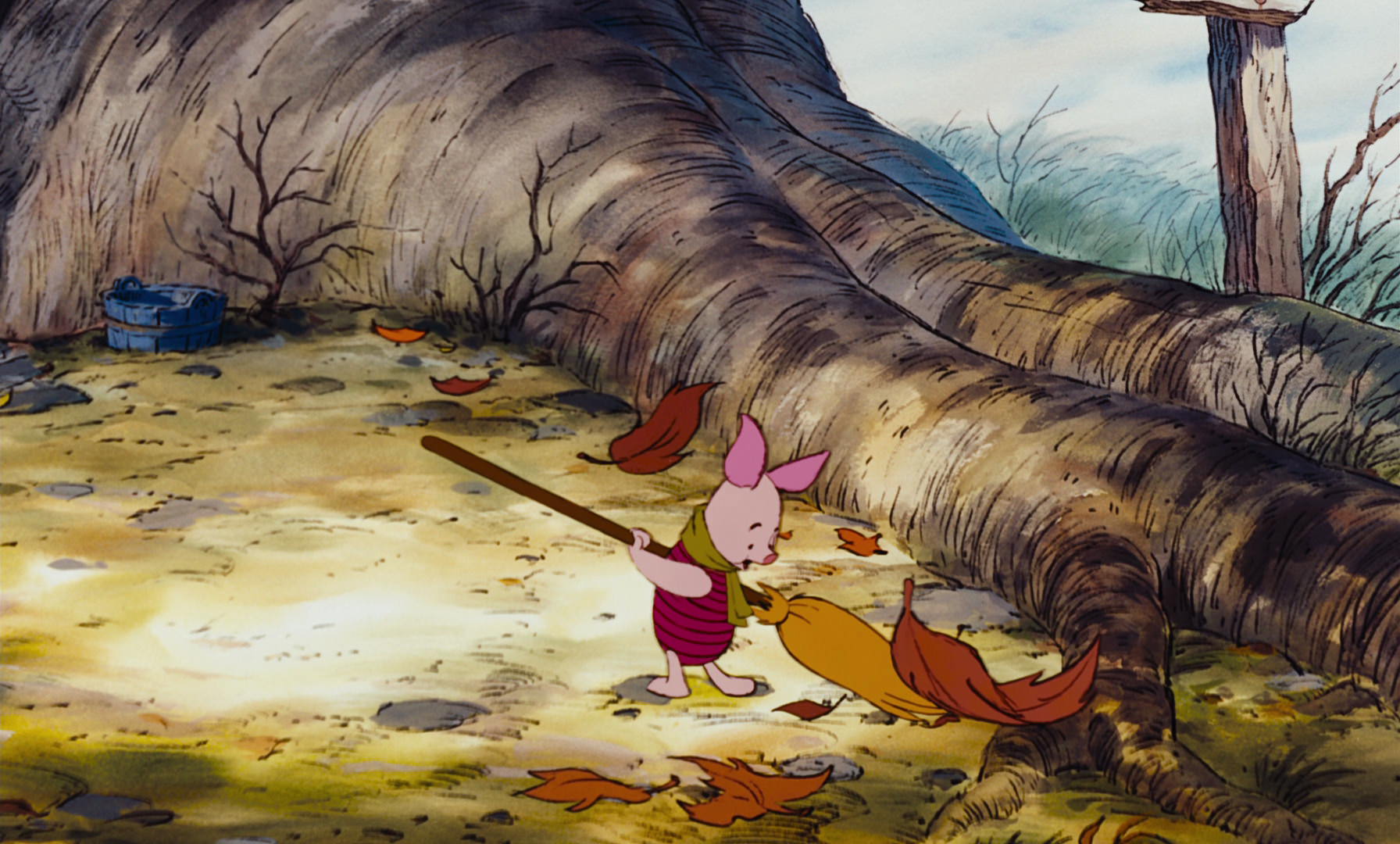
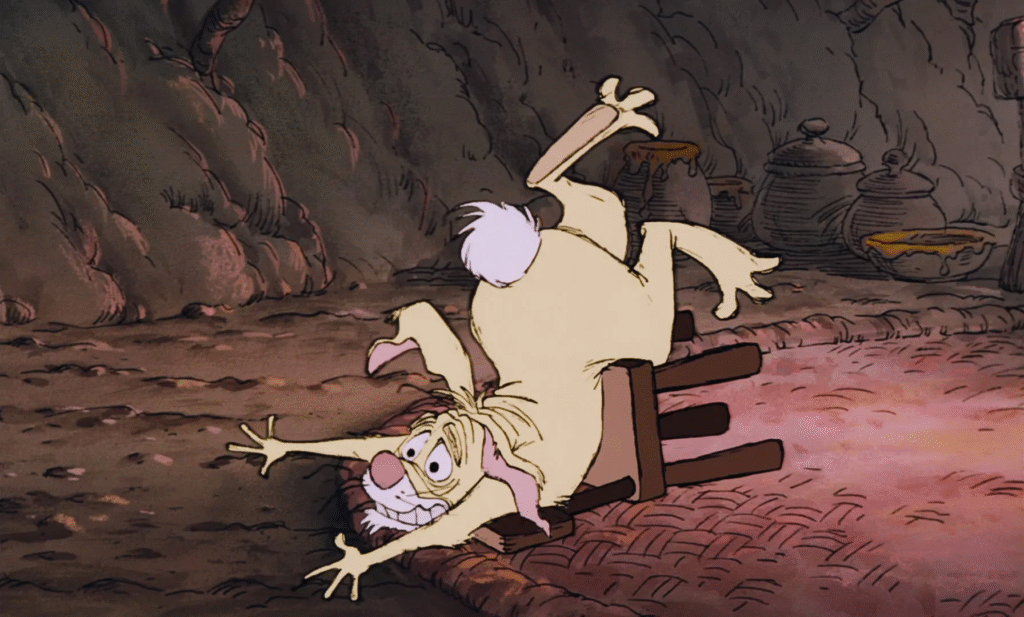
Disney adaptations are known for softening the darker aspects of their source materials. You’d think that wouldn’t be a thing with The Many Adventures of Winnie the Pooh, given the great innocence of the Winnie-the-Pooh books. But if you pay attention, some of the characters did kind of having dark shades that Disney airbrushed. The most famous example of this is Eeyore (voiced by story artist Ralph Wright) who is as pessimistic in the movie as he was in the books but not nearly as arrogant or bitterly, not to mention elaborately, sarcastic. Piglet (John Fiedler) is defined by his timidity in both the books and the movie but in the former, he also had a great deal of pride and defensiveness of which you don’t get as much in the film. He also could be rather competitive in the books and even had a jealous streak towards his best friend, Winnie-the-Pooh.[3]The very introduction to the first Pooh book brings this up. Disney’s Piglet is loveable in a less complicated way though he does get a great snarky line in the third featurette. (“Pooh, I don’t think Rabbit’s splendid idea worked.”) The character who comes across the most differently from the book is Rabbit (Junius Matthews) who is much more frazzled and panicky in the movie than the dignified, authoritarian literary version.[4]This is the only instance I can recall of the character in Disney’s later spinoffs and tie-ins being closer to the books. He’s also much more frequently the butt of the comedy. I don’t mind this as much as you’d think since while the character is different in the movie, he still feels like the kind of comedic character A. A. Milne could have written. Plus, Junius Matthews’s vocal performance is just so entertaining.
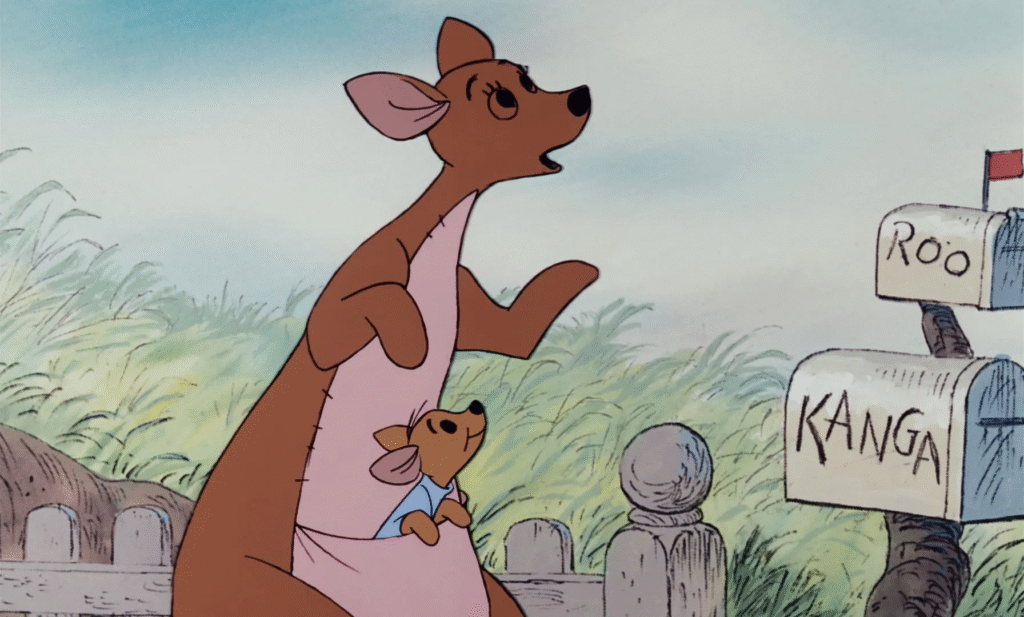
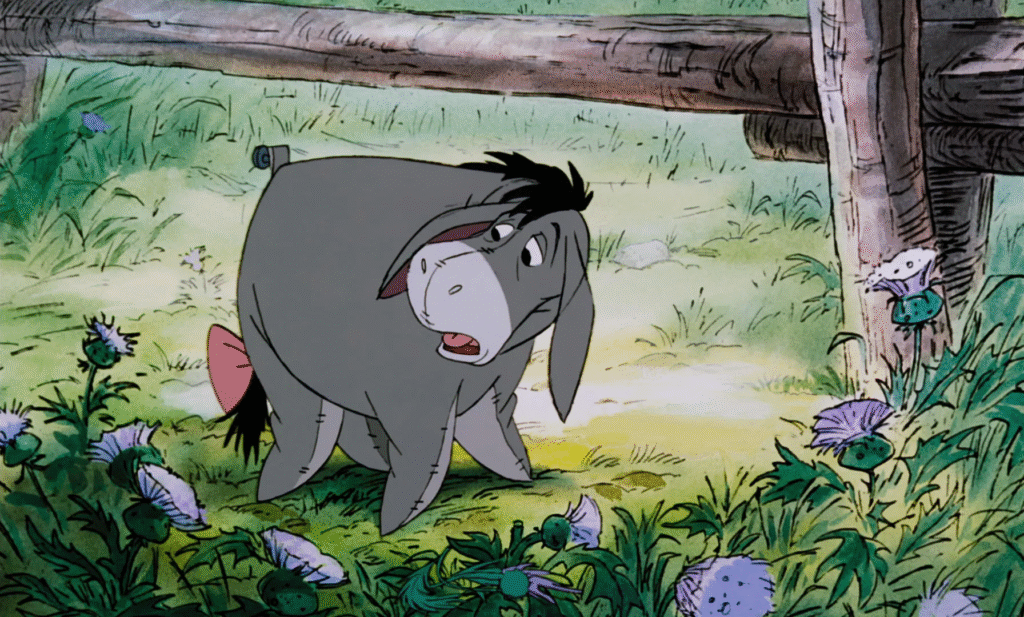
Since the Disney movie doesn’t adapt every single Pooh story, some characters inevitably get more focus than others. The ones who end up emerging as the leads are Winnie the Pooh himself (Disney veteran Sterling Holloway), Piglet, Rabbit and Tigger (Paul Winchell.) In spite of not being the focus though, Owl (Hal Smith) still emerges as a vivid and funny personality if not as rounded as he was in Milne. The same can’t be said for Kanga (Barbara Luddy, another regular Disney voice actor) and Roo (Clint Howard in the first two featurettes, Dori Whitaker in the third) who really don’t come across as that funny here. To be fair, they were probably the least funny and least developed characters in the books too, but I’d say they were still funnier there than were here. If there’s one supporting character I really wish had more development though, it’s Eeyore. That’s not because Disney made him unfunny. Sure, his acerbic personality may not have been unchanged but he’s still hilarious. For being a story artist rather than a voice actor, Ralph Wright turned in a great performance. It’s just too bad that there’s not more of him in the movie compared to the books.[5]In 1983, he’d star in a new featurette, Winnie the Pooh and a Day for Eeyore but despite adapting some top-notch material from the Pooh books, the visuals, voice acting and comedic timing in … Continue reading
It should also be mentioned that there’s a character who is original to the movie, but I’ll get to him later.
The Framing Device
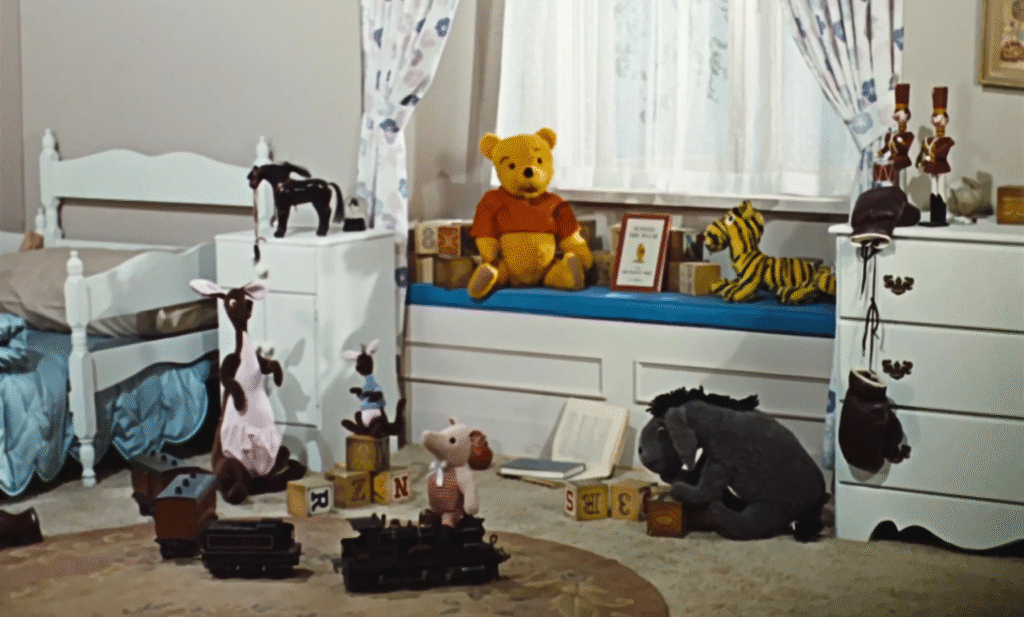
In the first Pooh book, the one titled simply Winnie-the-Pooh[6]By the way, Milne hyphenated Pooh’s full name and Disney didn’t. I’m going to spell it based on which version of the character I mean., it’s established that all the stories are being told to Christopher Robin by the narrator (presumably his parent) before bathtime and that the characters are all based on his stuffed animals. This doesn’t really feature in the second book, The House at Pooh Corner, except for the introduction.[7]Or, rather, the contradiction. You have to read it to understand. The Many Adventures uses a somewhat different framing device. It begins in a live action bedroom featuring the stuffed animal versions of the Pooh characters.[8]Even Rabbit and Owl who aren’t supposed to be toys, but I digress. An invisible narrator (Sebastian Cabot) informs us that this room belongs to a boy called Christopher Robin. On a window seat is a book which opens up. The illustrations come to life and we’re off.
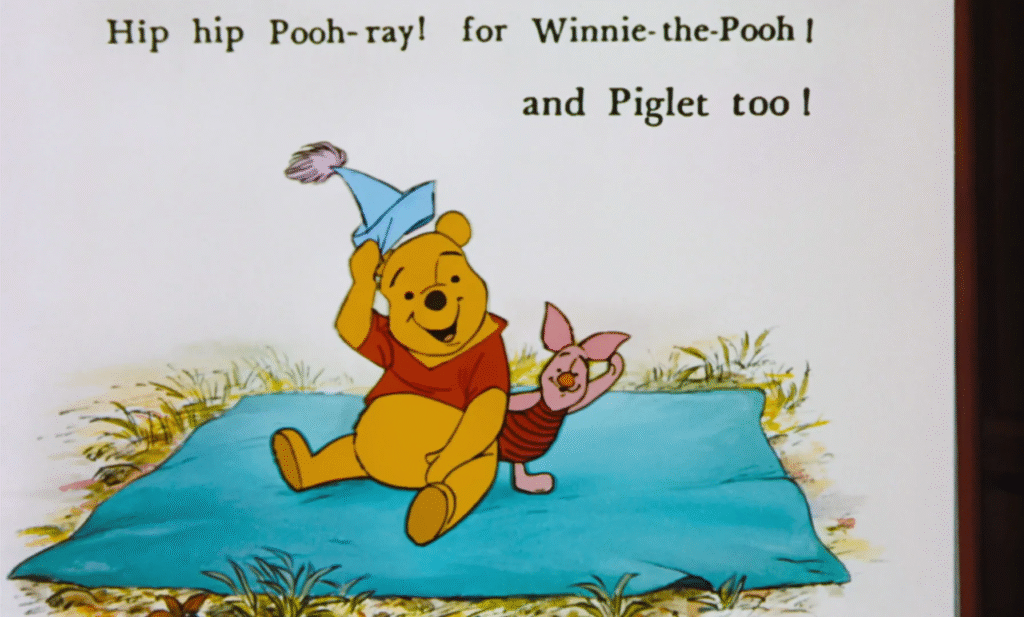
Now I’ve read that director Wolfgang Reitherman was not a fan of the Pooh books[9]Though it should be noted that some of the leading animators on The Many Adventures were, mainly Frank Thomas, Ollie Johnston and Milt Kahl. and even initially resented being assigned them to adapt. But I really don’t feel a lack of affection, watching this. A lot of the toys we see in Christopher Robin’s room are the kind of toys that were depicted in Ernest H. Shepard’s illustrations for Milne’s two books of verse for children, When We Were Very Young and Now We Are Six, such as toy soldiers, a rocking horse and a train set. Yeah, they’re 60s-era American versions of those things rather than Edwardian English ones but still. Even the window seat on which the book stands is arguably reminiscent of the window seat in Christopher Robin’s nursery in Now We Are Six.
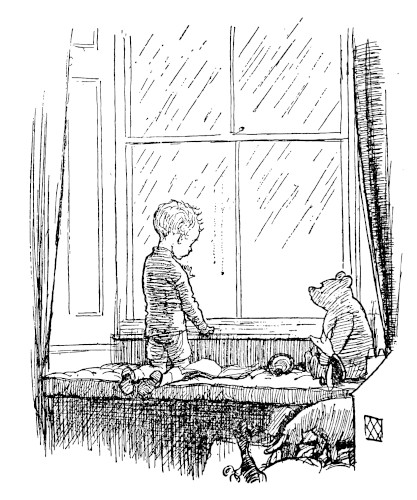
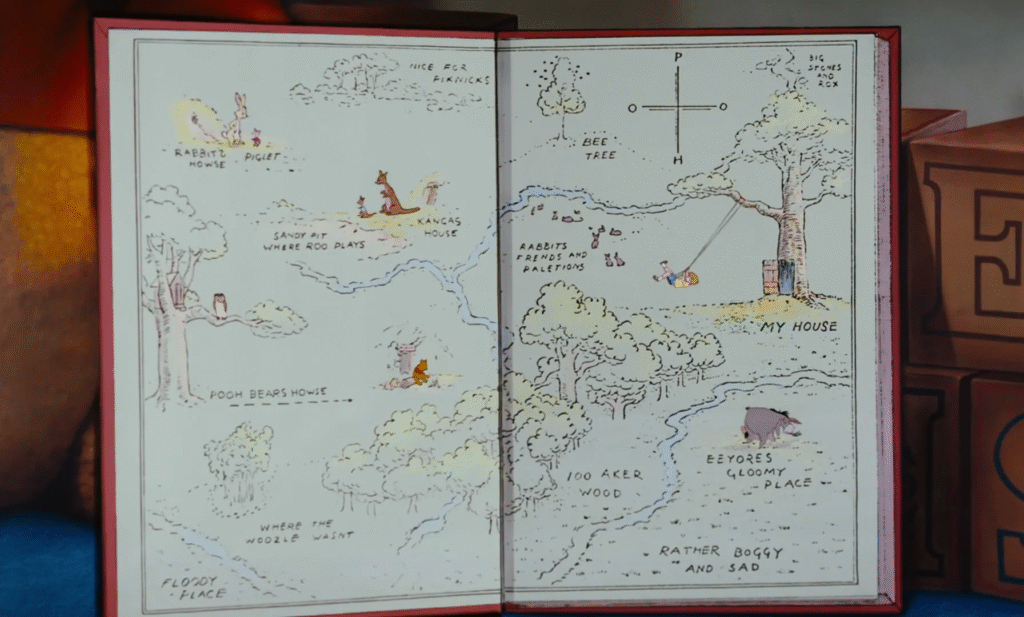
The map at the beginning of the book within the movie is clearly modeled on Shepard’s map from the real book and that’s not the only nod to the original you’ll notice if you’re quick eyed. While we don’t get Pooh’s arms being stuck, we do get a nod to his name’s origin from the book as we see him blowing an insect from his nose. (“Pooh!”) Even if the director wasn’t a fan of the Pooh books himself, it seems like he wanted to please viewers who were fans.
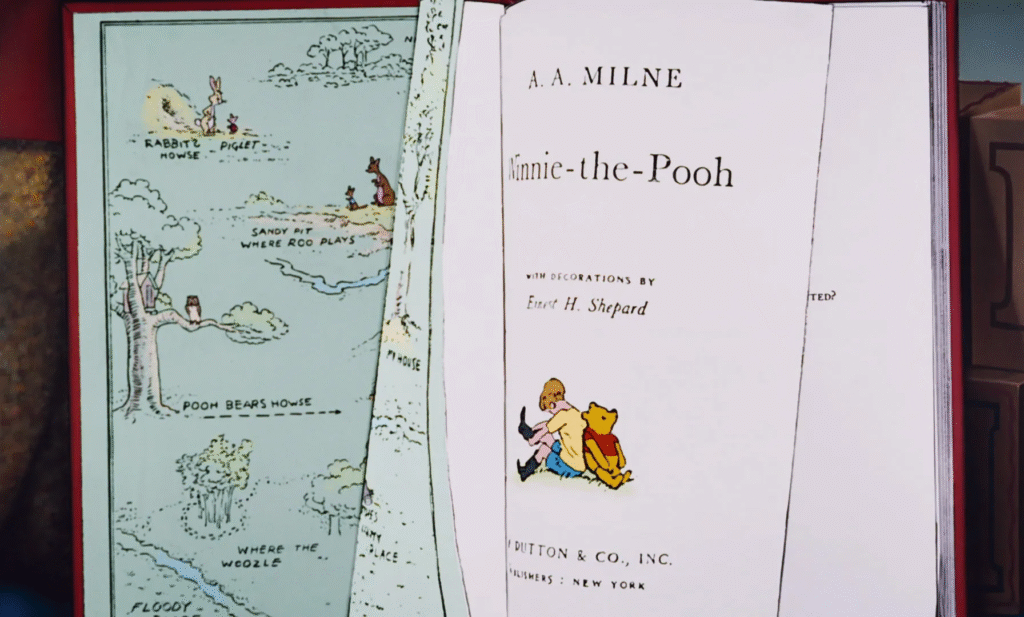
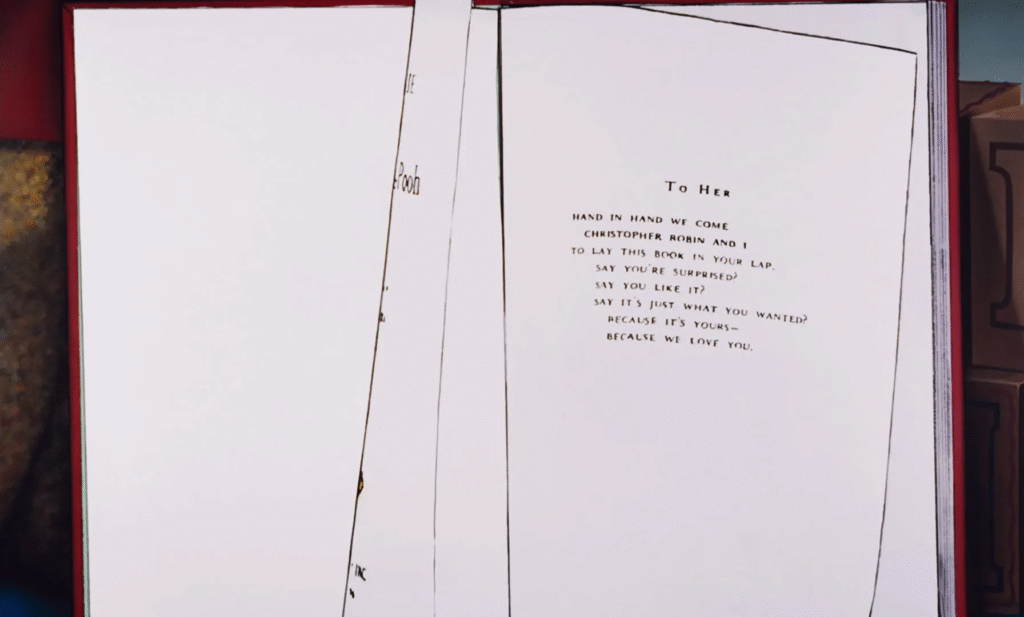
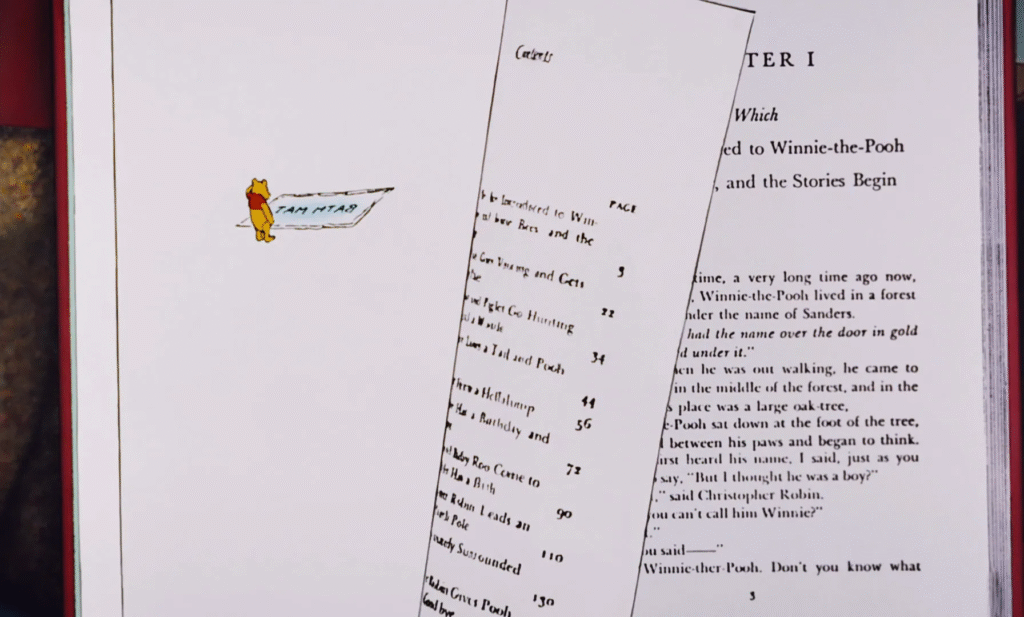
I consider it a happy accident that The Many Adventures of Winnie the Pooh was animated with xerox technology since it means the pencil lines on the animated characters are frequently visible, evoking the original illustrations by E. H. Shepard.
Now on to the individual segments.
Winnie the Pooh and the Honey Tree (1966)
This featurette is based on the first two chapters of Winnie-the-Pooh, the one In Which We Are Introduced to Winnie-the-Pooh and Some Bees, and the Stories Begin and the one In Which Pooh Goes Visiting and Gets Into a Tight Place. Why adapt two stories instead of just one? Beyond needing to fill out the runtime, I suspect the motivation lay in fact that roughly half the Pooh stories end without the main characters having accomplished anything. That’s part of their easygoing nature. Whether our heroes’ goal is to get some honey or to catch a Woozle or to get the bounces out of Tigger, they’ll usually have forgotten about it by the time the chapter is over. Sometimes even when they do accomplish a goal, such as discovering the North Pole, it’s more accurate to say they feel like they’ve accomplished it. You could argue this important to the spirit of Pooh, but Disney probably felt it would be unsatisfying. Fortunately, the first two chapters of the first book blend into one story pretty seamlessly. The first one is about Pooh trying and failing to get a meal. The second one is about him getting one but with unintended negative consequences.
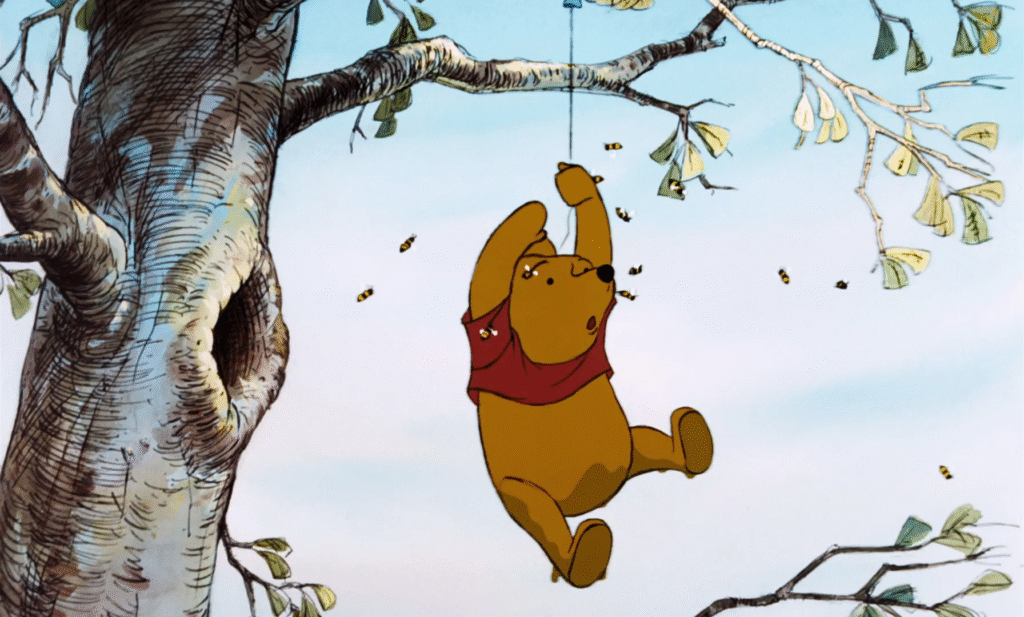
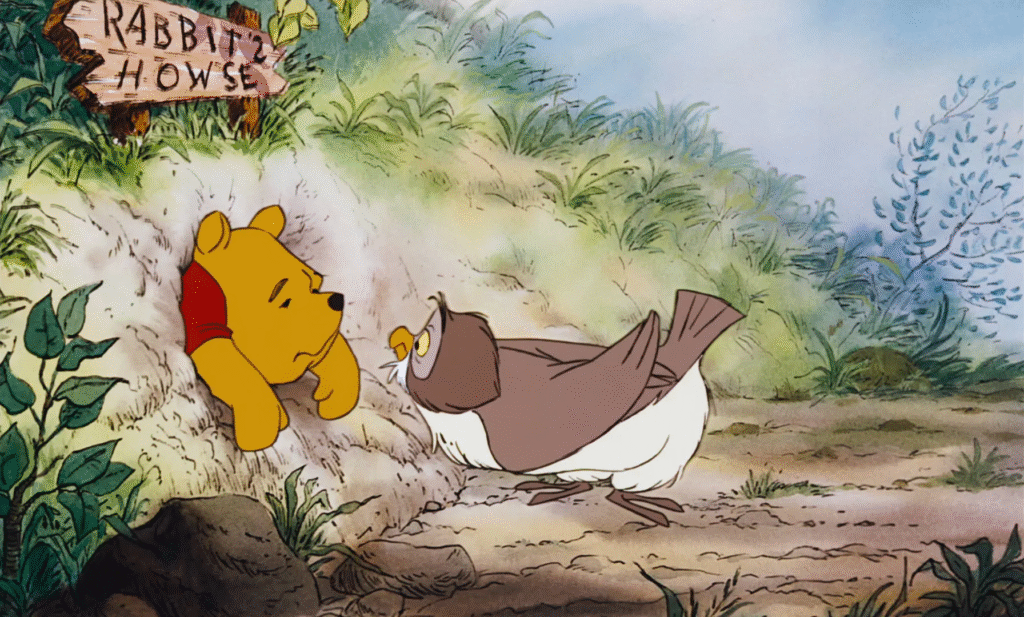
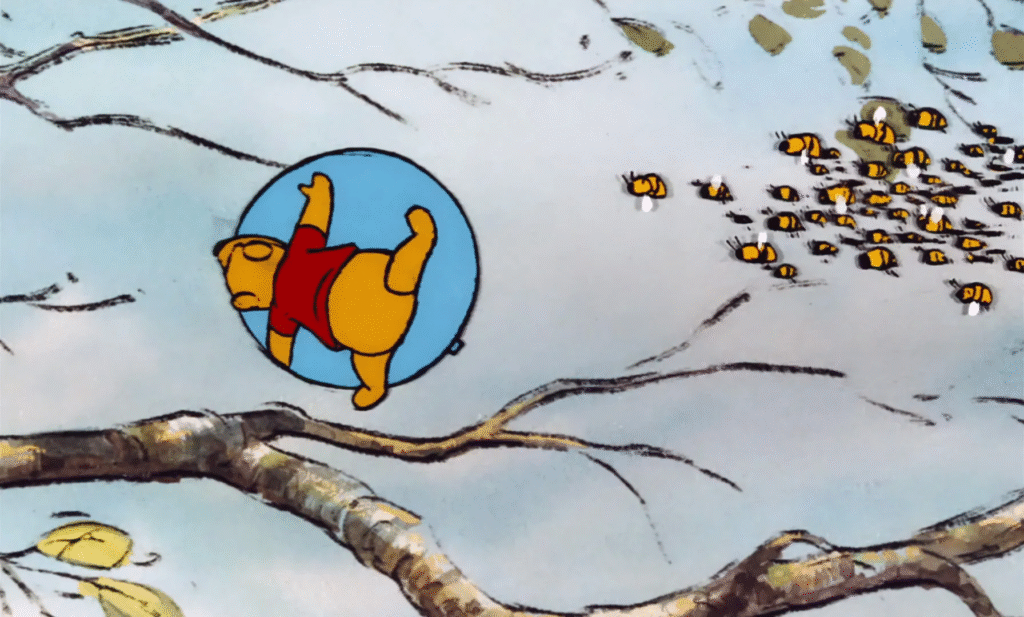
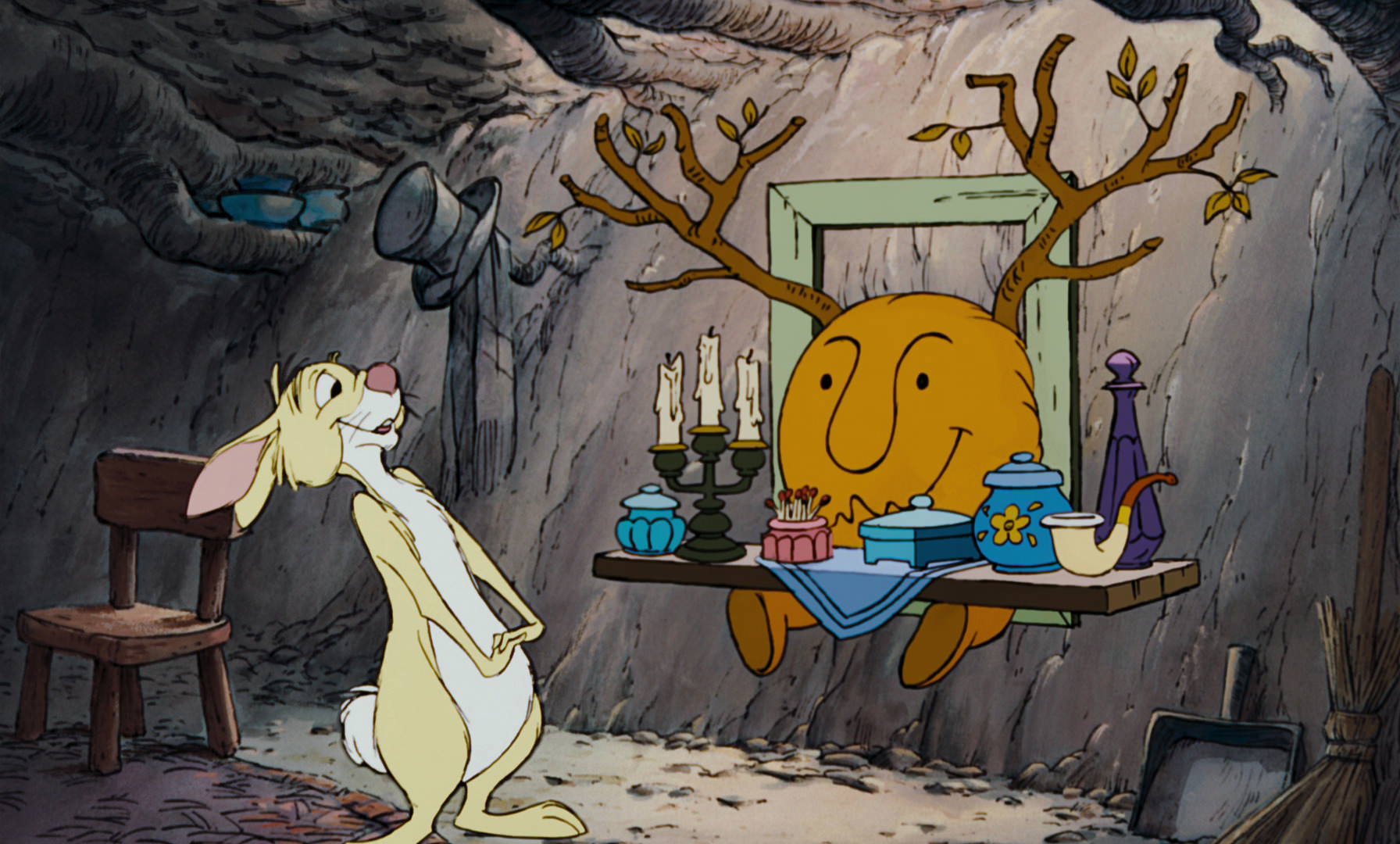
If the main appeal of the Pooh books is their verbal humor, I don’t see how The Honey Tree doesn’t capture that. It includes most, if not all, of the funniest jokes from the corresponding sections of the text. Criticism of its humor being too American as opposed to British comes more from it adding slapstick. For example, in the book, the balloon-borne Pooh simply decides that the bees he’s trying to rob are “the wrong sort of bees” and has Christopher Robin get him down from the sky by shooting the balloon with his gun which he always takes with him.[10]Who says the Pooh books don’t resonate with Americans? This adaptation replaces that with a chase scene that begins in the air and continues on the ground after all the air has gone from the balloon. Along similar lines, Rabbit goes beyond using Pooh’s legs as a clothesline when the bear is stuck in his door and turns his “south end” into a decorative center piece. In the film’s defense, the ending of the balloon incident in the book is a bit anticlimactic and the stuff with Rabbit is quite fun.
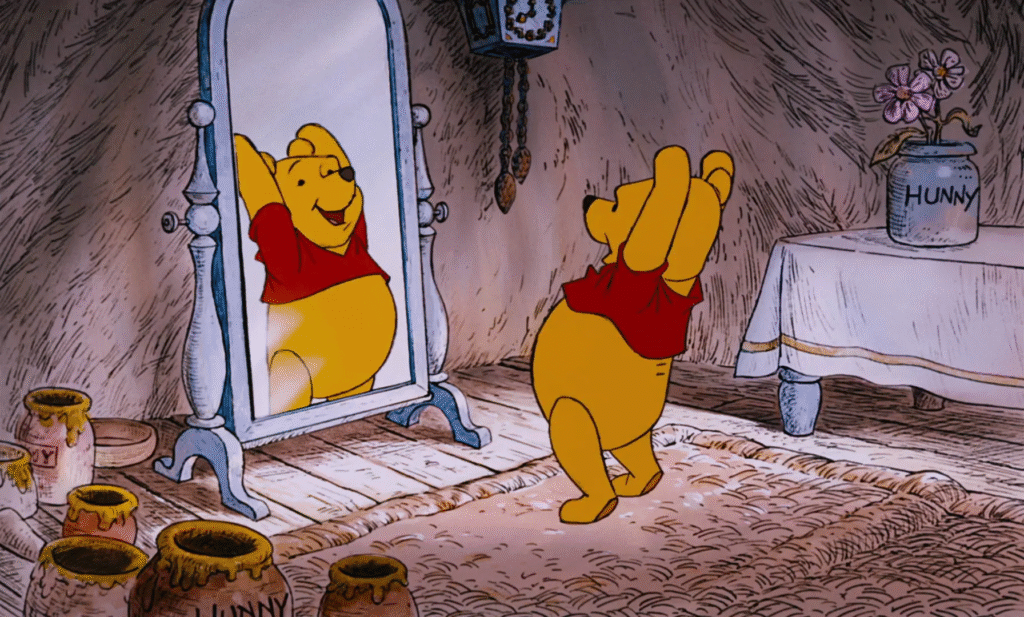
Part of me wishes the jingly songs by Richard M. and Robert B. Sherman used Milne’s poetry from the Pooh books but it’s not as big a part as might be supposed. As they are, the songs are great and broadly within the spirit of the Pooh books’ poetry. I’m especially a fan of the song Pooh sings as he does his Stoutness Exercises in which he explains that their purpose is to make him hungry, so he’ll eat and get stouter. (Pooh was talking about body positivity before anyone else!) The voice acting is also great in general, especially Sterling Holloway’s delightful turn as the loveable bear.
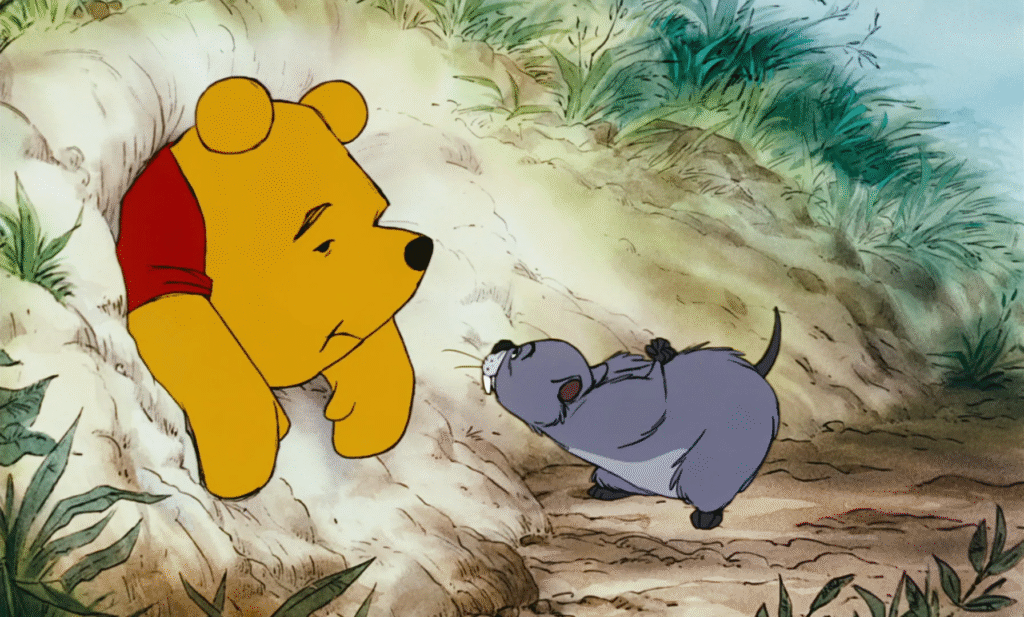
In addition to the chapters from the book I already mentioned, the featurette also features an allusion to Chapter 4 of Winnie-the-Pooh, In Which Eeyore Loses a Tail and Pooh Finds One. (Christopher Robin[11]This character was originally voiced by the director’s son, Bruce Reitherman, whose American accent was a big source of contention in England. He was redubbed for The Many Adventures but … Continue reading is seen nailing the donkey’s tail back on and Eeyore swishes it around to make sure it won’t come off again.) The only characters to appear in the first two chapters of Winnie-the-Pooh were Christopher Robin, Pooh and Rabbit but The Honey Tree also features, besides Eeyore, Owl, Kanga and Roo. No Piglet or Tigger though. The latter is understandable since he wasn’t introduced until the second Pooh book, but the former is more eyebrow raising. Apparently, many of the featurette’s English detractors felt that he’d been replaced by the new and distinctly American character of Gopher (Howard Morris)[12]Ernest T. Bass on The Andy Griffith Show. I can’t blame any Milne fan for feeling offended by the idea that Milne’s cast of characters needed an American animal with an American accent and American persona.[13]And, honestly, even if they wanted an animal to appeal to Americans, I feel like the turkey is more iconically American than the gopher. But while he’s not as funny any of the characters from the book, Gopher does have his moments. I love the meta joke about his business not being in the (phone)book and the scene of him almost ruining the extreme weight loss program for Pooh (“Don’t! Feed! The! Bear!”) is my favorite bit specific to this adaptation. When he’s asked to dig Pooh out of Rabbit’s doorway, he takes a good long look at him and says, “The first thing to be done is get rid of that bear! He’s coverin’ up the whole project!” That sounds like an A. A. Milne joke to me.
Winnie the Pooh and the Blustery Day (1968)
Is it weird that this is my favorite of the three featurettes artistically but my least favorite as an adaptation?
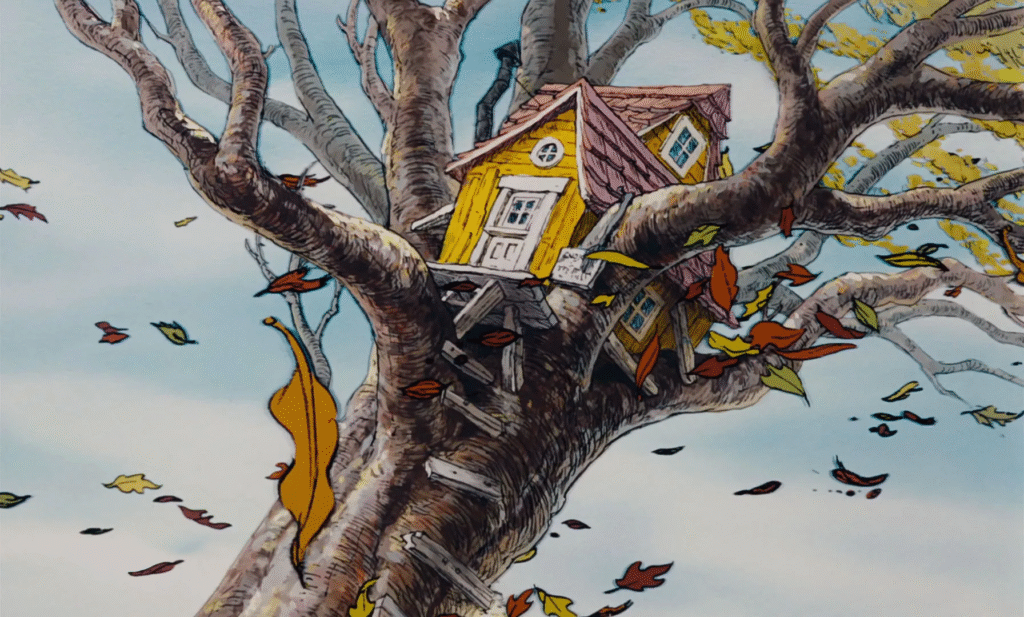
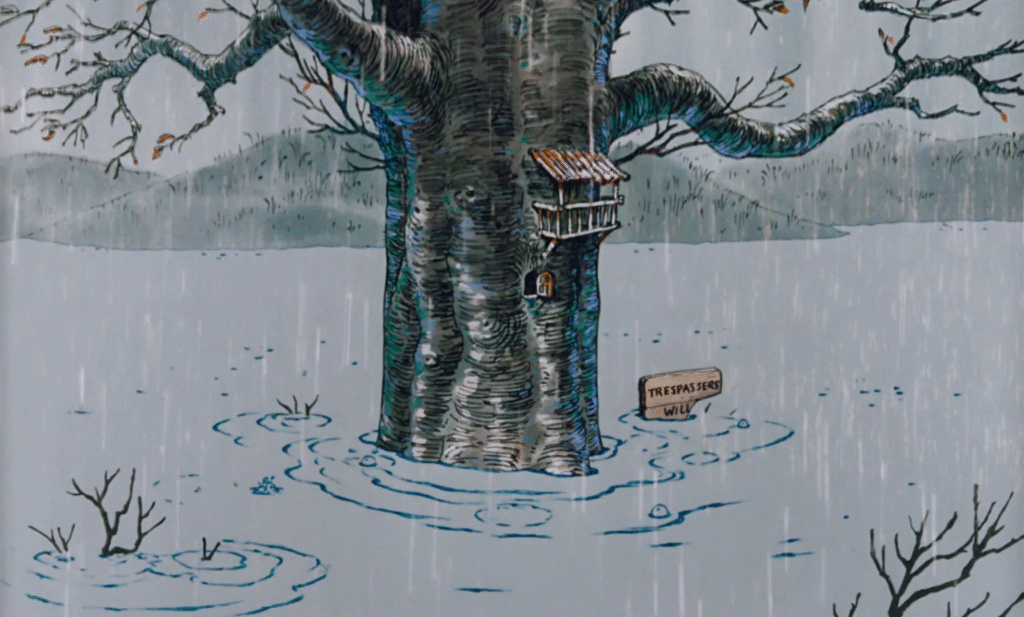
Winnie the Pooh and the Blustery Day mainly adapts the climactic chapters of Winnie-the-Pooh (the ones In Which Piglet Is Entirely Surrounded by Water and In Which Christopher Robin Gives Pooh a Party and We Say Goodbye) and The House at Pooh Corner (the ones In Which Piglet Does a Very Grand Thing and In Which Eeyore Finds the Wolery and Owl Moves Into It.) In between them, it adapts part of Chapter 2 of The House at Pooh Corner (the one In Which Tigger Comes to the Forest and Has Breakfast.) There’s also a nightmare sequence, one of the few scenes in The Many Adventures that tries to be scary, about Heffalumps and Woozles, imaginary beasts from Chapter 3 and Chapter 5 of Winnie-the-Pooh, (the ones In Which Pooh and Piglet Go Hunting and Nearly Catch a Woozle and In Which Piglet Meets a Heffalump.)[14]We also briefly see Eeyore building a house for himself out of sticks, a reference to the first chapter of The House at Pooh Corner (In Which A House Is Built at Pooh Corner for Eeyore.) The house in … Continue reading
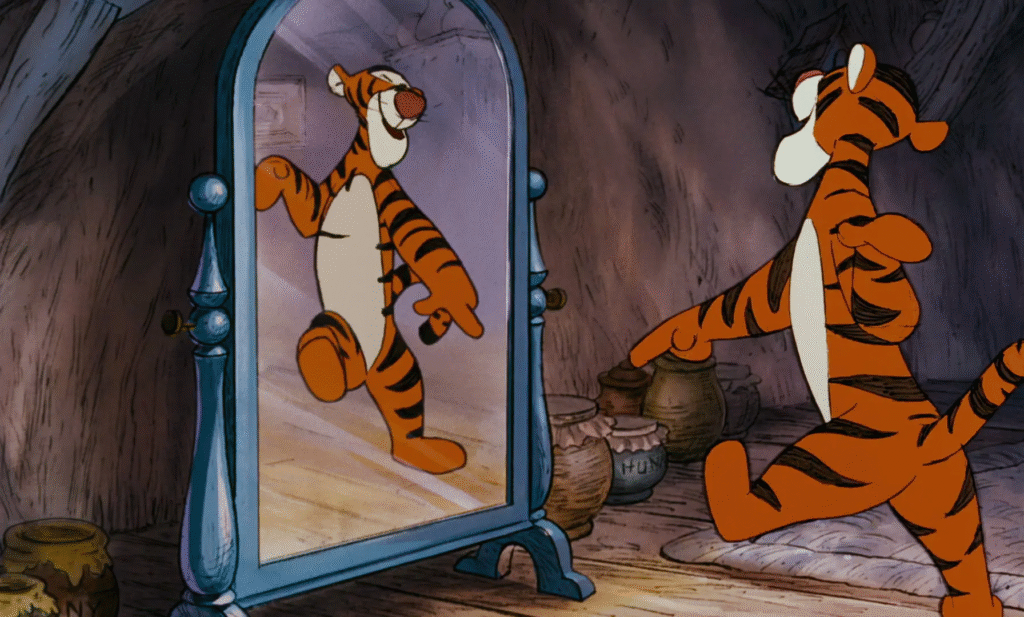
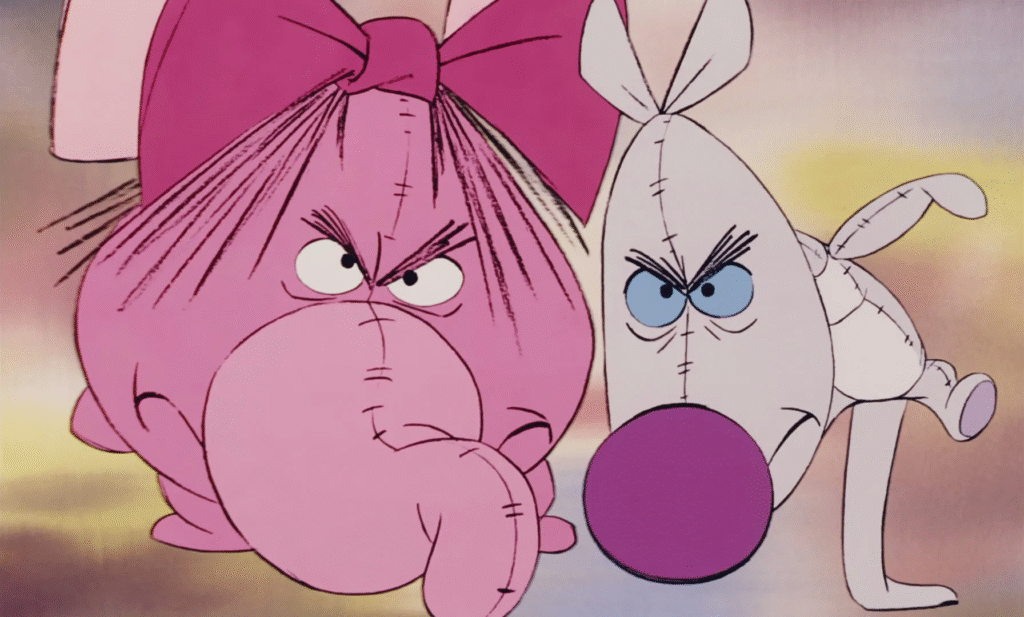
As you can tell by the titles of the chapters, Piglet and Tigger make their Disney debuts here. Tigger is really only the focus of one scene that exists to introduce him for the next featurette, but Piglet is one of the main characters in Blustery Day‘s story which is one of the reasons I’m inclined to favor it. Since I was a Very Small Animal myself as a kid, I related to him. Sure, I wrote above that Piglet is more complex in the book but he’s still great here. John Fiedler’s vocal performance is delightful.
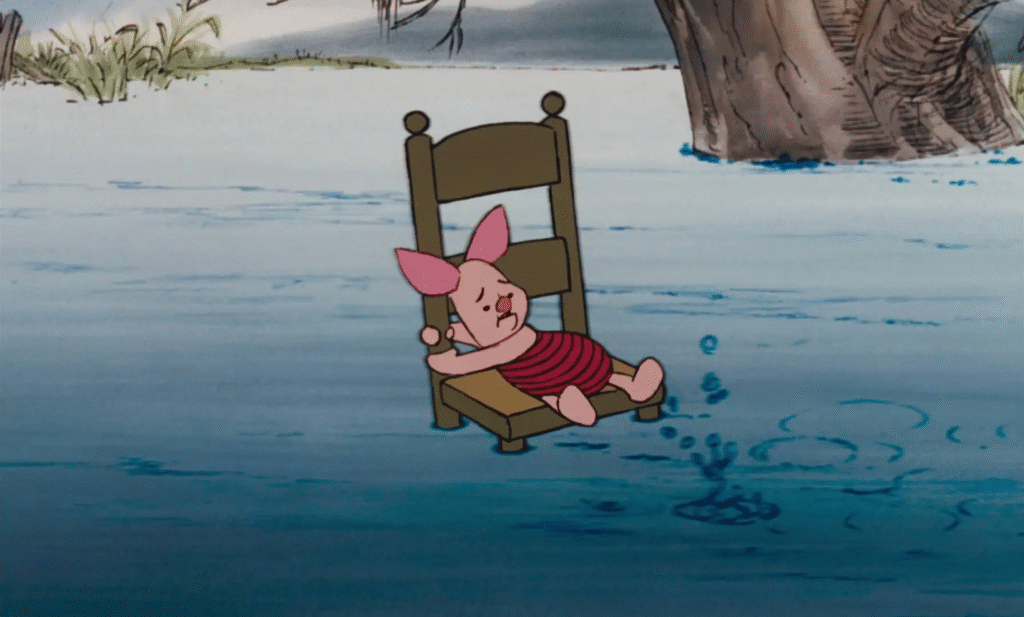
However, I have a problem with how Pooh saving him from the flood is adapted. In the literary Winnie-the-Pooh, Pooh comes up with a clever idea to rescue his friend. This was a great moment for him. In the movie, all he does is happen to be in the same area as him when he’s in danger and wrongly gets credited with saving him by Christopher Robin. Why the filmmakers thought this would make for a better ending is beyond me. To be fair though, since this was only the second Pooh cartoon, it wouldn’t really have had the same effect as it did after an entire book of him being a Bear of Very Little Brain. Neither does Blustery Day include Piglet’s act of bravery that saved Pooh and Owl when they were trapped in Owl’s house in The House at Pooh Corner.[15]Come to think of it, that was also the result of a surprisingly crafty idea on Pooh’s part. Of course, since this was the animated Piglet’s very first appearance onscreen, having him behave uncharacteristically heroic right off the bat would have made even less sense than Pooh behaving uncharacteristically clever so early. The adaptation does include Piglet’s later moment of self-sacrifice, which also ends up being a great moment for Pooh. This was one of the most emotional moments in the books[16]Not that that’s saying much since being emotional is beside the point of most of the Pooh stories. Still, it’s saying something. and the movie does a very nice job with it.
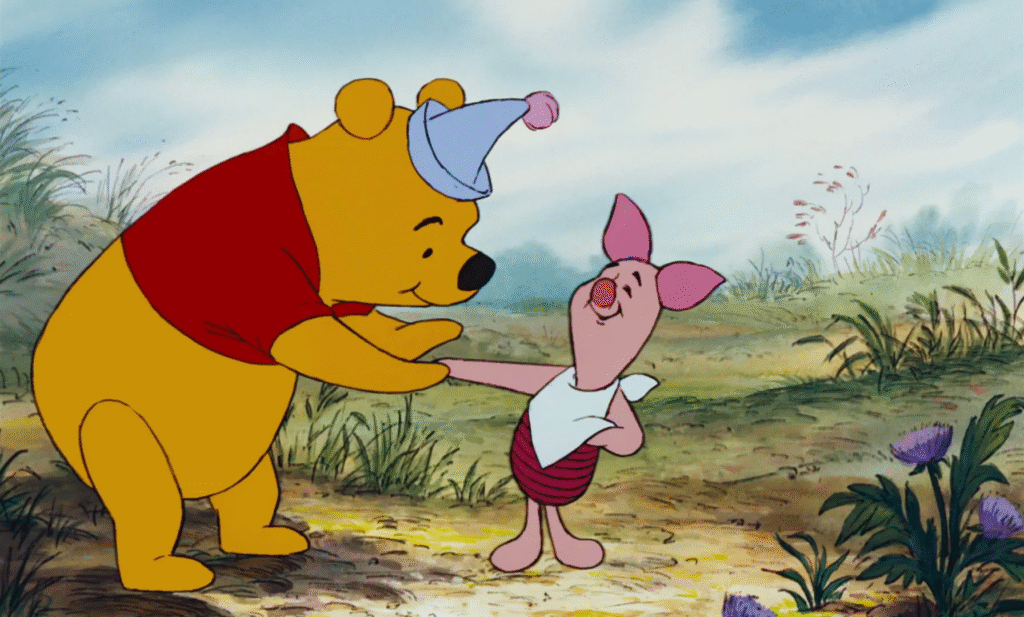
Why is this Pooh featurette my favorite when it makes what I consider such misguided changes to the source material? Well, the songs are even better than the ones in Winnie the Pooh and the Honey Tree. In particular, I think A Rather Blustery Day and The Rain, Rain, Rain Came Down, Down, Down are underrated gems. And I don’t feel like Blustery Day comes across as lacking in affection for the books. There’s something fun about just how many Pooh stories it crams into its runtime. It also helps that since the main chapters from the books it adapts are the ones where the characters in the most physical danger, relatively speaking, they lend themselves to elaborate Disney-style slapstick comedy better than the chapters adapted by Honey Tree did. Perhaps because of that, the scenes of slapstick are much funnier. I especially love the one with Owl, Pooh and Piglet in Owl’s dangerously swaying tree. All three characters are hilariously in character with Piglet being concerned about the physical danger, Owl being concerned in the family anecdote he’s relating to his guests and Pooh being concerned with getting some honey to eat. Just because it’s slapstick doesn’t mean it can’t be about character.[17]By the way, one of Owl’s speeches has a fun allusion to Edward Lear’s classic nonsense poem, The Owl and the Pussycat.
Winnie the Pooh and Tigger Too (1974)
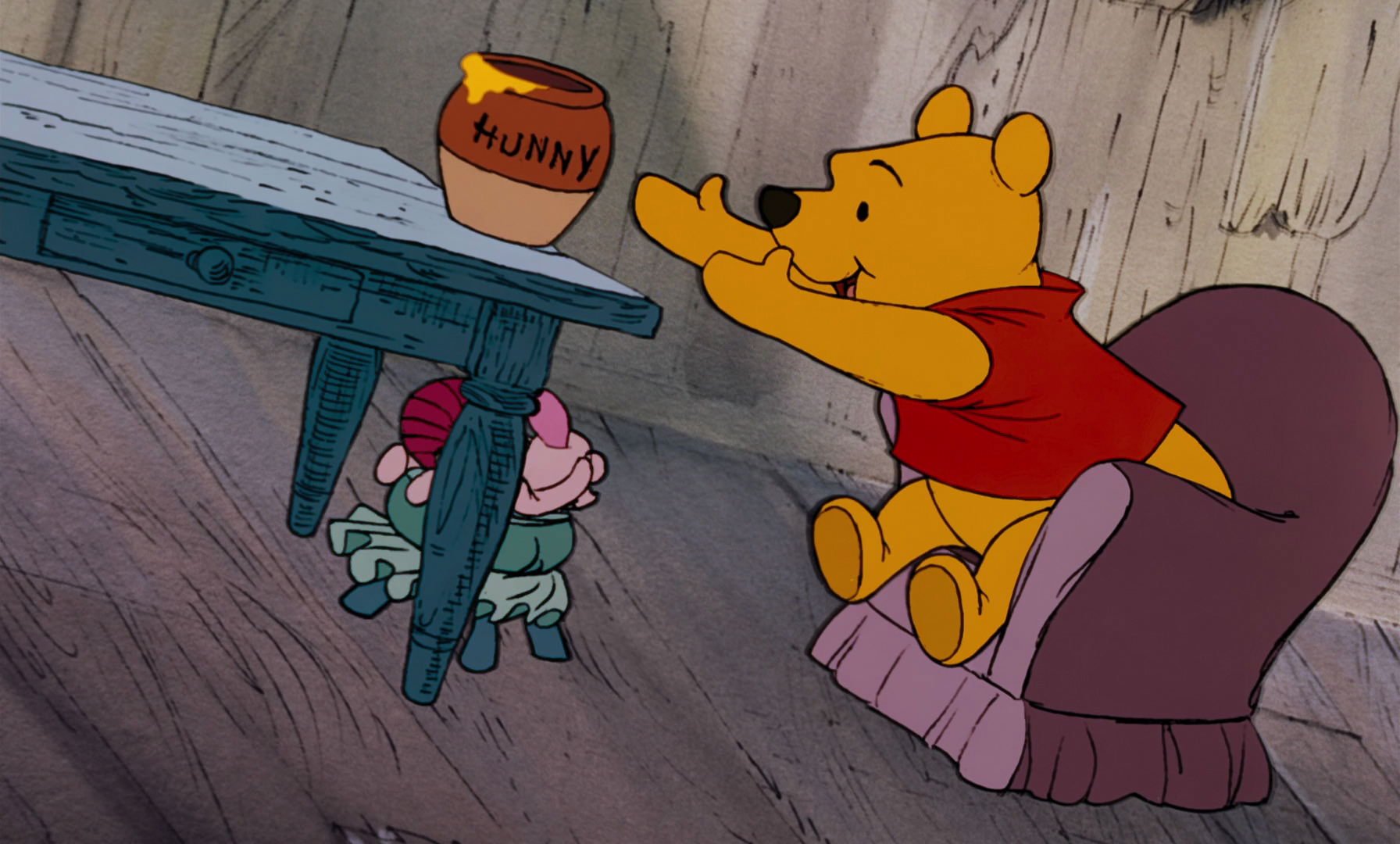
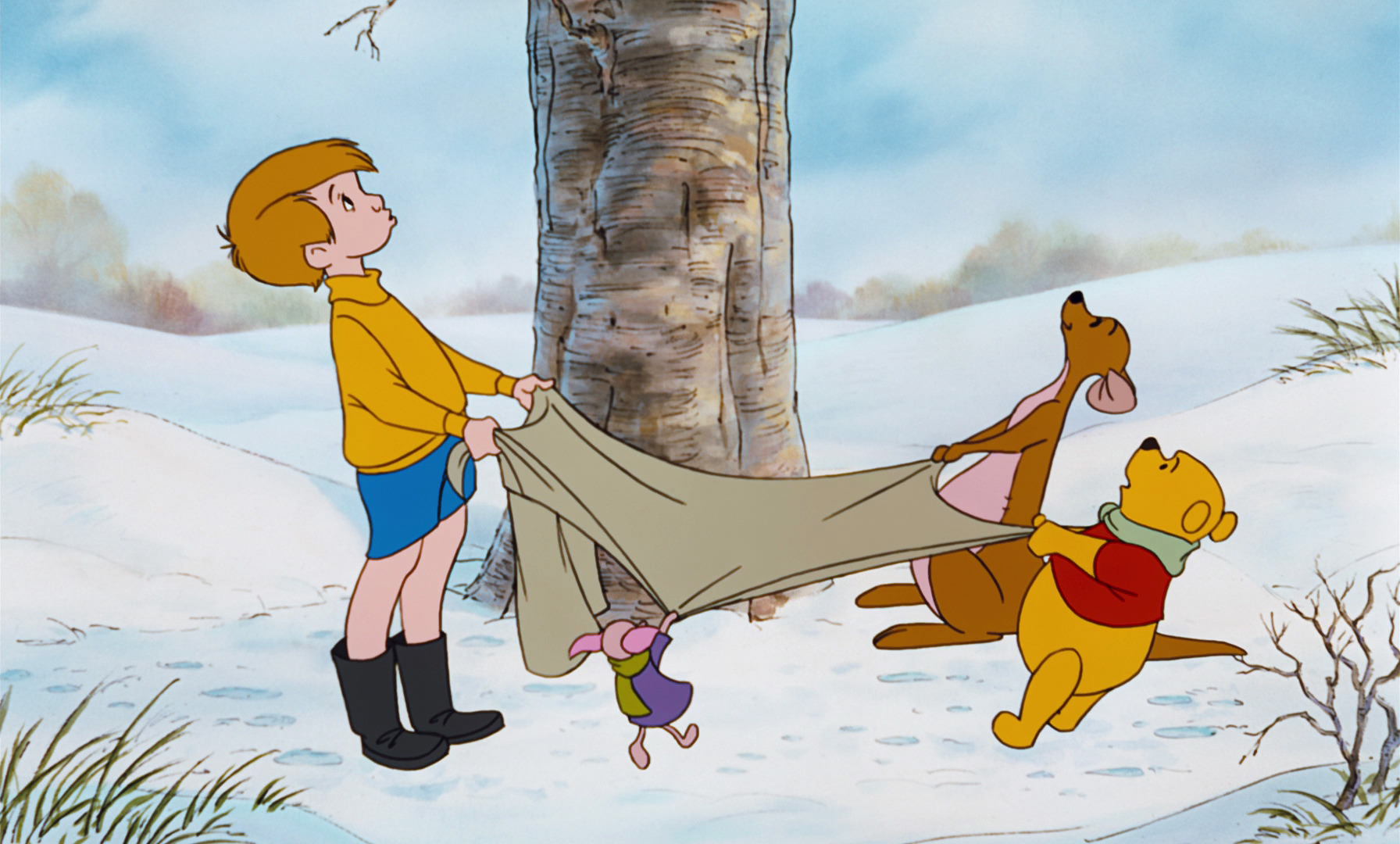
This featurette is mainly based on Chapters 7 and 4 of The House at Pooh Corner, (the ones In Which Tigger is Unbounced and It Is Shown That Tiggers Don’t Climb Trees.) It also inserts Chapter 3 of Winnie-the-Pooh, In Which Pooh and Piglet Go Hunting and Nearly Catch a Woozle.[18]Attentive viewers will note that a snatch of dialogue between Piglet and Pooh in that scene was already used in Blustery Day though with the speakers reversed. Why did I just list Chapter 7 of House at Pooh Corner before Chapter 4? Because the movie puts them in that order. I actually think this change in the chronology works well, making it so that we don’t see Tigger really humbled until after we’ve seen the other characters fail to “unbounce” him.
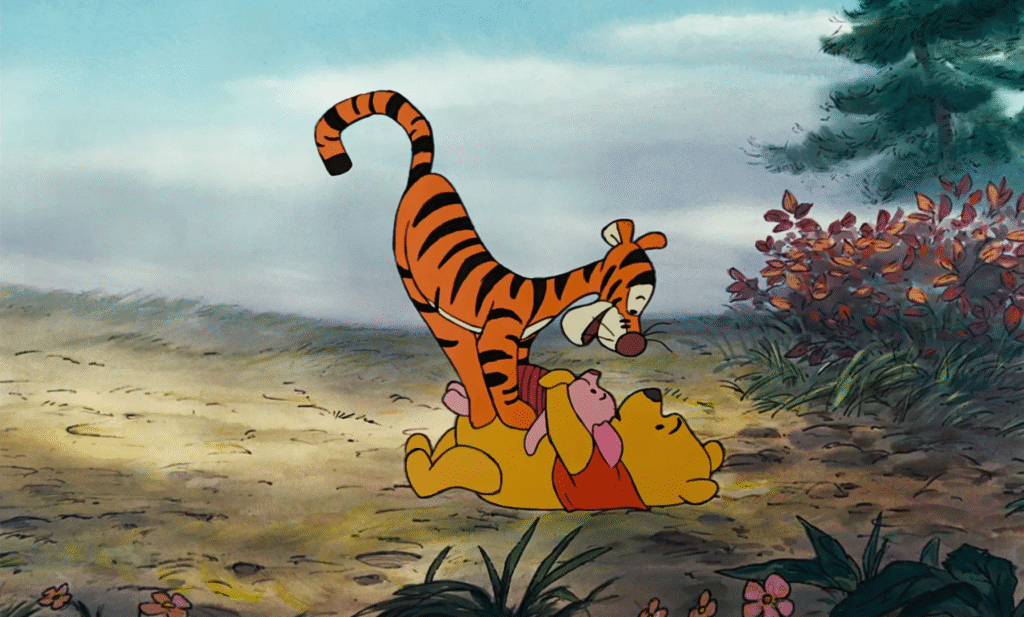
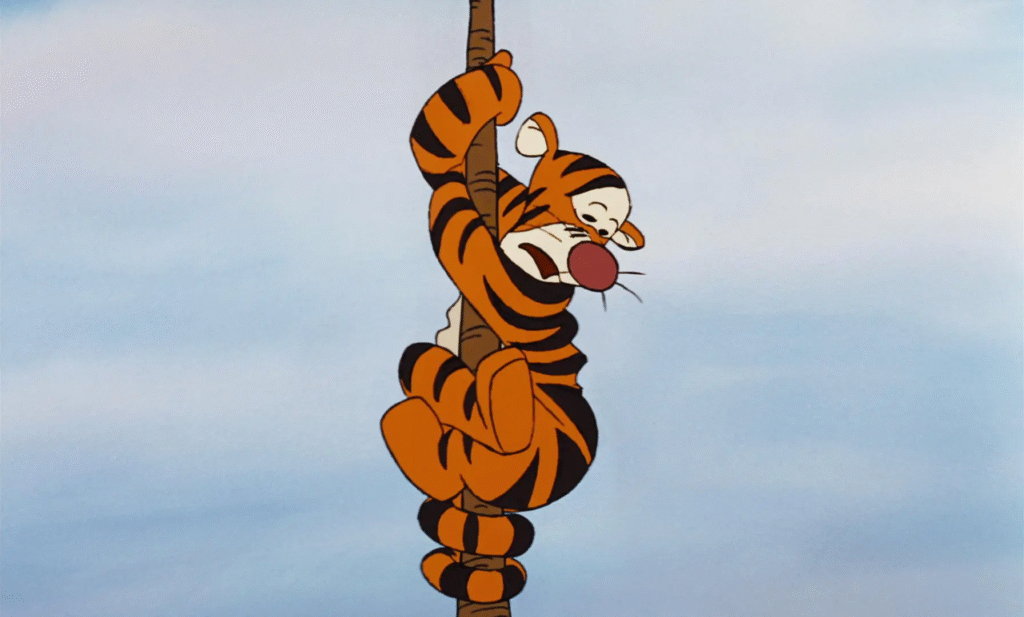
A side effect of having Chapter 7 take place before Chapter 4 though is that Rabbit can’t be reconciled to Tigger at the same point he does in the book. Well, the movie could have done that, but it would have meant his character arc would have been over halfway through the featurette. Instead, it creates some new drama[19]Well, it’s dramatic compared to the movie’s generally comedic tone. for the characters so that Tigger remains a nuisance to Rabbit and Rabbit remains hostile to Tigger until the end. Happily, I think the added drama works well.
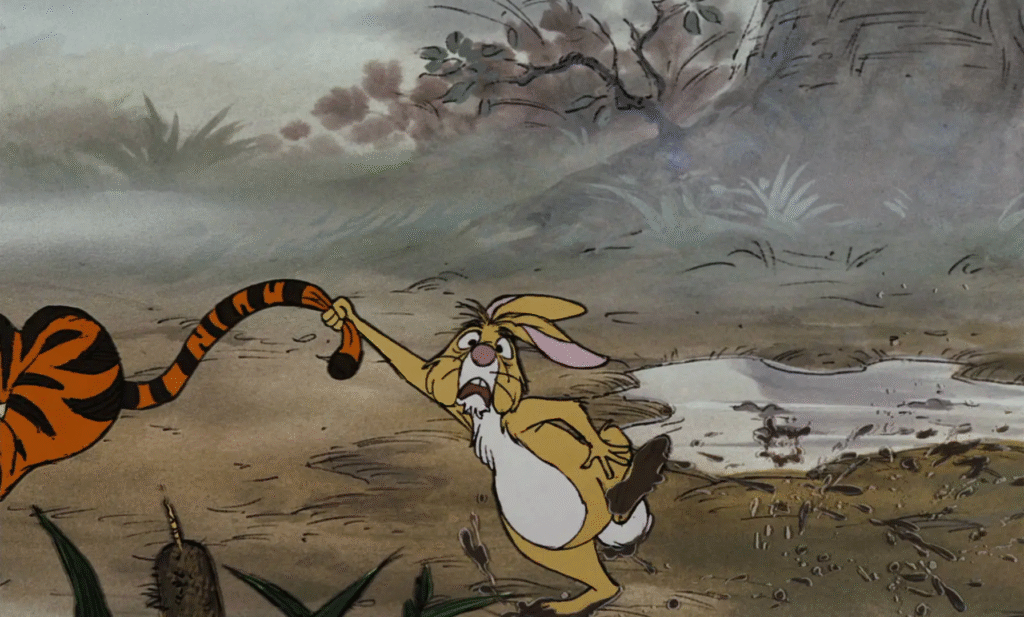
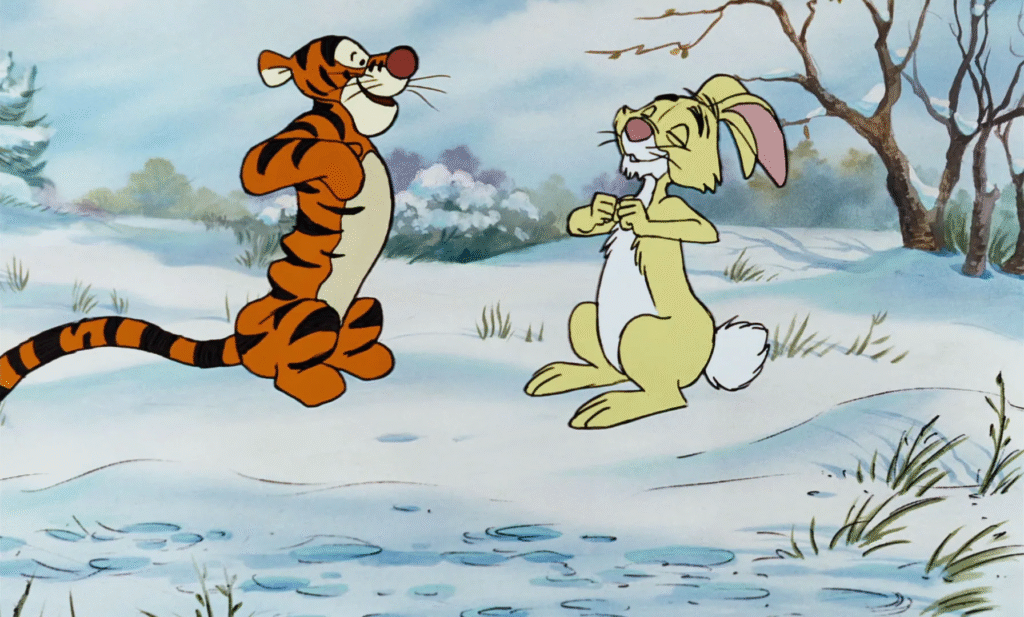
Unlike the other two featurettes, this one only features the characters necessary to the story. Owl, Gopher and Eeyore are all absent even though the last one was present for one of the scenes in the book that Tigger Too adapts. There are also no new songs, only reprises of The Wonderful Thing About Tiggers from Blustery Day. I mean that as an observation, by the way, not a criticism. As much as I enjoy how Blustery Day is crammed with things from the books, there’s something to be said for not forcing characters into a story when you can’t think of anything for them to do. And I’d rather have no new songs than songs that paled in comparisons to those from earlier segments.
The Epilogue
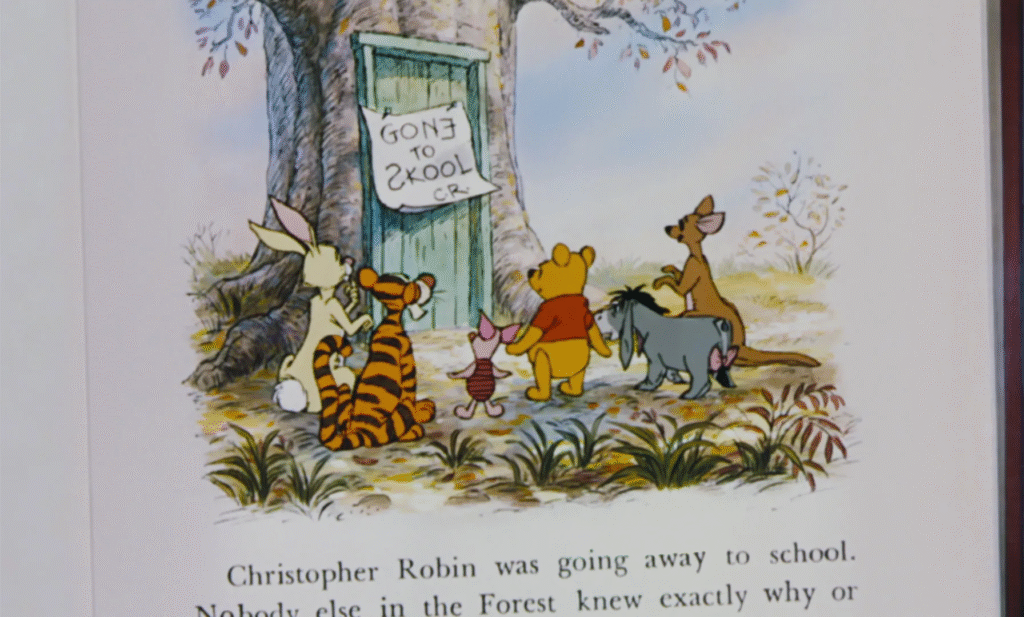
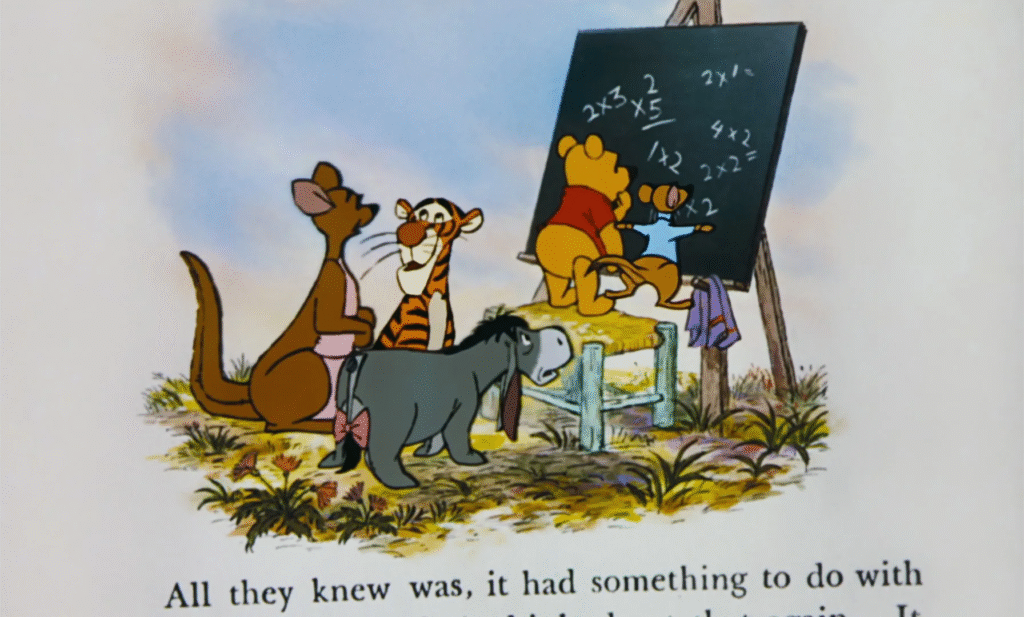
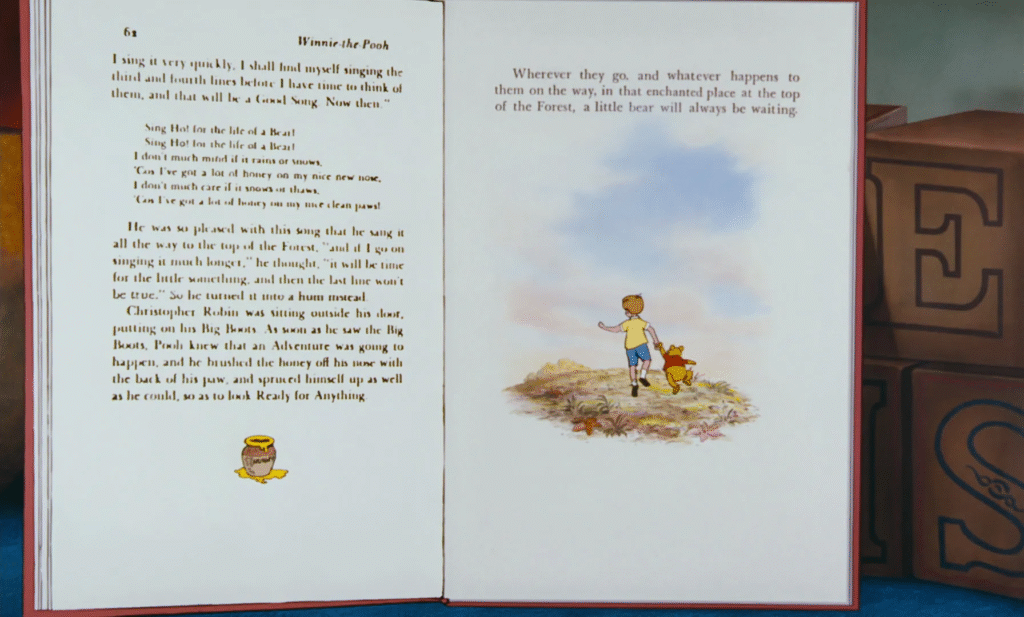
[20]The above image on the left is an allusion to Chapter 5 of The House at Pooh Corner, (the one In Which Rabbit Has a Busy Day and We Learn What Christopher Robin Does in the Mornings.) The one on the … Continue readingThe added ending to The Many Adventures of Winnie the Pooh is a truncated version of the final chapter of The House at Pooh Corner, In Which Christopher Robin and Pooh Come to an Enchanted Place and We Leave Them There. It’s mainly Christopher Robin and Pooh’s final conversation about the joys of doing Nothing, of which Christopher Robin will no longer be able to partake-or not as often anyway. It’s one of the more downbeat endings to a Disney movie.[21]I’ve written before that there was a time when Disney movies didn’t always have happy endings, but that time wasn’t very long and even then, it wasn’t as if Disney movies … Continue reading Being truncated, the scene isn’t as moving as it is in the source material, mainly because the relationship between these two characters hasn’t really been a focus since Winnie the Pooh and the Honey Tree, but it’s still touching.
Conclusion
Actually, “not as great as the source material but still pretty great” is a good summary of my opinion on this adaptation in general. It could be better. Besides the issues I’ve mentioned above, The Many Adventures of Winnie the Pooh could have been improved if the creators had planned the featurettes out as a movie in advance. Then the exciting events in Winnie the Pooh and the Blustery Day could have functioned as the climax of the whole film just as they did for Winnie-the-Pooh and The House at Pooh Corner (respectively.) That would have given them more time to develop Pooh’s relationships with Piglet and Christopher so the few dramatic moments would have packed even more punch.[22]Maybe this is because I haven’t read enough books but the literary Pooh and Piglet’s friendship is actually one of my favorites in literature. There also could have been some foreshadowing of Christopher Robin’s farewell to childhood, as there was in The House at Pooh Corner, so the ending would have come less from nowhere. And I’m miffed that in all these years, Disney has never adapted the third chapter of The House at Pooh Corner (the one In Which A Search Is Organdized and Piglet Nearly Meets the Heffalump Again) e.g. the funniest Pooh story ever!
But it’s not like I’m actually thinking about any of those potential improvements while I’m watching the movie-certainly not stuff about structure! I’m just relaxing and soaking in the charm. Both the original books and The Many Adventures of Winnie the Pooh are appealing to and appropriate for very small children yet have a wit that engages adults too.[23]Also, more adults may find the cuddly stuffed animals appealing than they’d admit. Actually, they’re arguably aimed the most at adults who work or have worked with little kids-well, assuming they look on those kids with some degree of fondness. Such adults have probably met a few Poohs, Piglets, Rabbits and Tiggers in their time-or been one of them themselves. (We were probably all Eeyore at some point in our adolescence.) You could even argue that each of the episodes that make up The Many Adventures represents a different aspect of childhood. Winnie the Pooh and the Honey Tree is about childish appetites. Winnie the Pooh and the Blustery Day is about childhood fears. And Tigger Too is about overexuberant kids who drive adults crazy. Hmm, maybe the movie does have a good structure after all.
Any lingering resentment towards The Many Adventures in the UK seems to be less to do with the adaptation itself and more to do with how the Pooh characters have come to be defined in American minds by the Disney versions. I think it’s unfortunate that Disney held onto the copyright so firmly and that we haven’t gotten to see other takes on the material.[24]Well, there were those weird Russian Pooh adaptations. I’d have loved to see what the people who made The World of Peter Rabbit and Friends and The Wind in the Willows (1995) could have done with the Pooh books. They’d likely have captured aspects of them that Disney didn’t and doubtless been more authentically British. But it’s also possible Disney’s hold on the rights to the characters has saved us from less faithful adaptations being made. If The Many Adventures of Winnie the Pooh has to be The Winnie the Pooh for many people…eh, things could be worse.
Bibliography
Finch, Christopher. (2000) Winnie the Pooh: A Celebration of the Silly Old Bear. Disney Enterprises, Inc.
Milne, A. A. (1994) The Complete Tales and Poems of Winnie-the-Pooh. Dutton Children’s Books.
Kothenschulte, Daniel. (2016) The Walt Disney Film Archives: The Animated Movies 1921-1968. Taschen Books.
References
| ↑1 | If it sounds like I’m criticizing this thing for being a cash grab, I’m not. There’s something to be said for fans being able to watch all three featurettes together. |
|---|---|
| ↑2 | It should be noted though that those reviews weren’t generally from English critics. |
| ↑3 | The very introduction to the first Pooh book brings this up. |
| ↑4 | This is the only instance I can recall of the character in Disney’s later spinoffs and tie-ins being closer to the books. |
| ↑5 | In 1983, he’d star in a new featurette, Winnie the Pooh and a Day for Eeyore but despite adapting some top-notch material from the Pooh books, the visuals, voice acting and comedic timing in that featurette would pale by comparison to the original three. |
| ↑6 | By the way, Milne hyphenated Pooh’s full name and Disney didn’t. I’m going to spell it based on which version of the character I mean. |
| ↑7 | Or, rather, the contradiction. You have to read it to understand. |
| ↑8 | Even Rabbit and Owl who aren’t supposed to be toys, but I digress. |
| ↑9 | Though it should be noted that some of the leading animators on The Many Adventures were, mainly Frank Thomas, Ollie Johnston and Milt Kahl. |
| ↑10 | Who says the Pooh books don’t resonate with Americans? |
| ↑11 | This character was originally voiced by the director’s son, Bruce Reitherman, whose American accent was a big source of contention in England. He was redubbed for The Many Adventures but I’m not sure by whom. I would assume it was by Timothy Turner who voiced Christopher Robin in the third featurette but according to behind-the-scenes material, John Walmsley, who voiced him in the second one, did his dialogue in the epilogue. |
| ↑12 | Ernest T. Bass on The Andy Griffith Show. |
| ↑13 | And, honestly, even if they wanted an animal to appeal to Americans, I feel like the turkey is more iconically American than the gopher. |
| ↑14 | We also briefly see Eeyore building a house for himself out of sticks, a reference to the first chapter of The House at Pooh Corner (In Which A House Is Built at Pooh Corner for Eeyore.) The house in the movie is less fortunate than the one in the book, not that Eeyore would expect anything better. |
| ↑15 | Come to think of it, that was also the result of a surprisingly crafty idea on Pooh’s part. |
| ↑16 | Not that that’s saying much since being emotional is beside the point of most of the Pooh stories. Still, it’s saying something. |
| ↑17 | By the way, one of Owl’s speeches has a fun allusion to Edward Lear’s classic nonsense poem, The Owl and the Pussycat. |
| ↑18 | Attentive viewers will note that a snatch of dialogue between Piglet and Pooh in that scene was already used in Blustery Day though with the speakers reversed. |
| ↑19 | Well, it’s dramatic compared to the movie’s generally comedic tone. |
| ↑20 | The above image on the left is an allusion to Chapter 5 of The House at Pooh Corner, (the one In Which Rabbit Has a Busy Day and We Learn What Christopher Robin Does in the Mornings.) The one on the right is an homage to an illustration from Now We Are Six, one accompanying the poem Us Two. |
| ↑21 | I’ve written before that there was a time when Disney movies didn’t always have happy endings, but that time wasn’t very long and even then, it wasn’t as if Disney movies always ended tragically. |
| ↑22 | Maybe this is because I haven’t read enough books but the literary Pooh and Piglet’s friendship is actually one of my favorites in literature. |
| ↑23 | Also, more adults may find the cuddly stuffed animals appealing than they’d admit. |
| ↑24 | Well, there were those weird Russian Pooh adaptations. |