
The Chronicles of Prydain are a series of children’s fantasy adventure novels from the 1960s by Lloyd Alexander. They are beloved largely because of their characterizations. The Black Cauldron (1985) is an animated movie adaptation of the first two books in the series.[1]The title of the first of which is The Book of Three by the way. It is…not beloved.
Well, that’s not entirely true. The film does have something of a cult following but it’s also generally considered a terrible adaptation, unworthy of the source material. Since I just said the characters were the main thing that made the books great, you’d assume that the movie is really untrue to them.
But that is less true than you’d think.
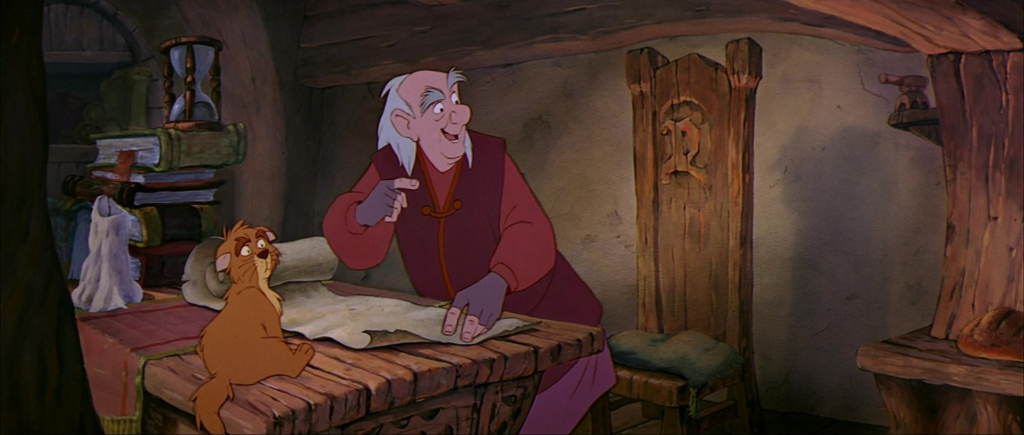
The titular cauldron is a magical artifact capable on creating an unstoppable army of deathless warriors. One of the only beings who knows the cauldron’s location is Hen Wen, an oracular pig. Wait. An oracular pig? Yeah, that’s a thing from Welsh mythology which served as the inspiration for the Prydain books. As I was saying, the villainous Horned King (voiced by John Hurt) seeks Hen Wen so he can use her to find the cauldron and use that to conquer the entire land of Prydain or possibly the world. Hen Wen’s caretaker, the old enchanter Dalben (Freddie Jones), divines this threat and sends his assistant, an ambitious young boy called Taran (Grant Bardsley), to take the pig to a safe hiding place. Stuff happens, Taran gains a motley crew of companions, and his quest evolves from hiding Hen Wen into trying to destroy the black cauldron itself before the Horned King finds it.
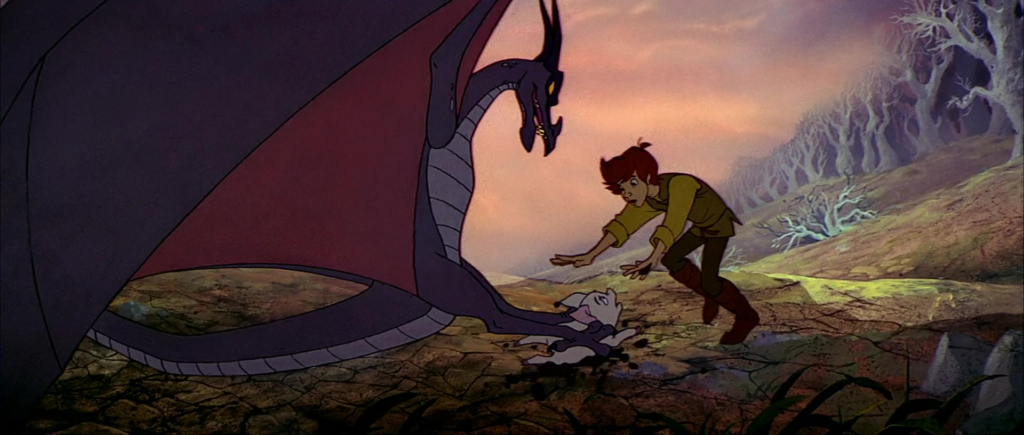
Most of the characters’ personalities and character arcs are the same as in the books. Taran still starts out complaining about his humdrum life and dreaming of glory in battle. He still messes up and feels guilty. He still learns the cost of true heroism and becomes maturer and more selfless. Gurgi (John Byner), the short hairy creature Taran picks up on his travels, still starts out a groveling, cowardly mercenary with a huge appetite and still ends up becoming a genuinely good and helpful friend. Fflewddur Fflam (Nigel Hawthorne), the boastful wandering bard[2]Sorry about all these unpronounceable names. Welsh, you know? still has his magic harp with the strings that break whenever he lies or exaggerates. Princess Eilonwy (Susie Sheridan) is still blunt, chatty and unflappable in the face of danger.[3]Well, she’s a bit less unflappable than in the books but I’m willing to believe that’s because the action scenes wouldn’t work as well if she didn’t display any fear. She still has a magical golden bauble that glows in the dark. She still offends Taran’s pride with her blunt words, and he still offends hers by not being immediately grateful for her help and speaking disparagingly of girls. They still make up and Eilonwy still ends up encouraging Taran when he’s feeling useless, and their friendship still becomes something more. The notes are all here. But there’s no music.
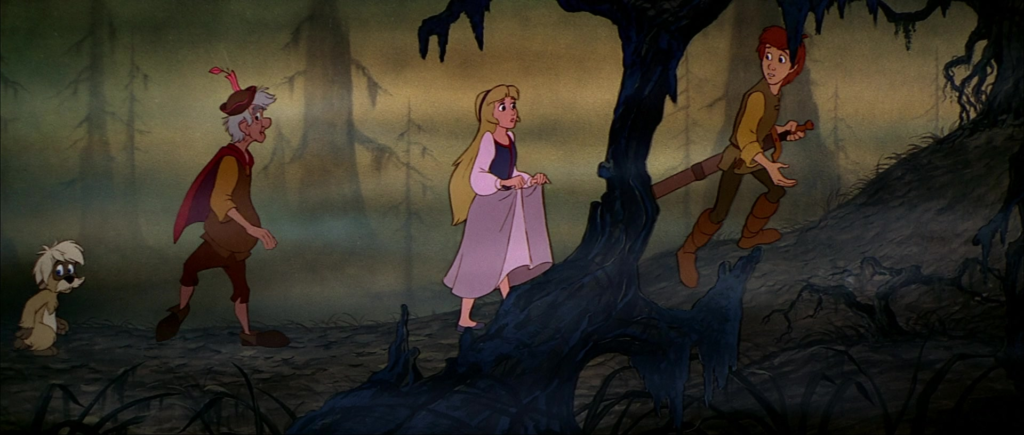
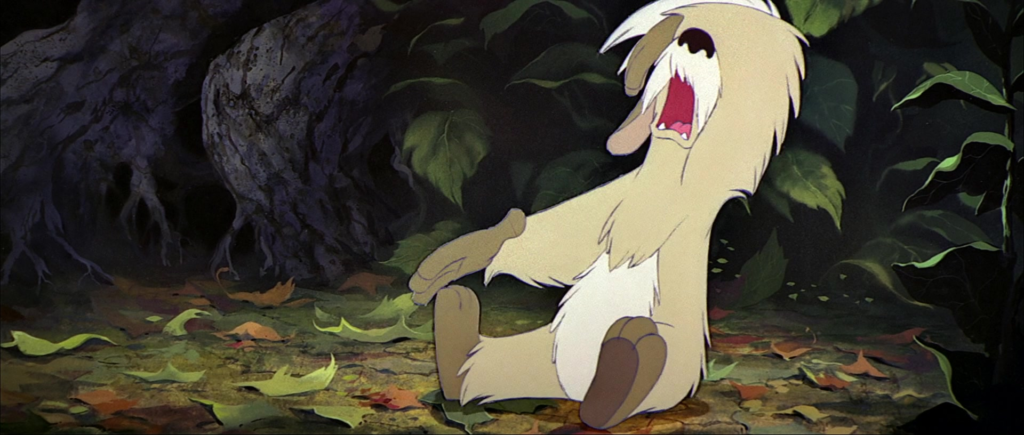
That’s largely because of the writing[4]This movie had so many writers, I’m not going to bother mentioning all their names. which includes little of Lloyd Alexander’s dialogue. To be fair, his distinctly literary humor, such as Eilonwy’s speech patterns (“It’s like putting your fingers in your ears and jumping down a well.” “That’s like asking someone to a feast, then making them wash the dishes!”), might not have translated well onscreen. Gurgi at least keeps his verbal tick of speaking of himself in third person, and he says “smackings and whackings” and “munchings and crunchings” a couple of times. But not only does the movie not have time to develop his character properly but the voice John Byner gives him is highly annoying. True, he’s supposed to start out that way, but he’s supposed to wind up being endearing and, for me anyway, the film never accomplishes that part.
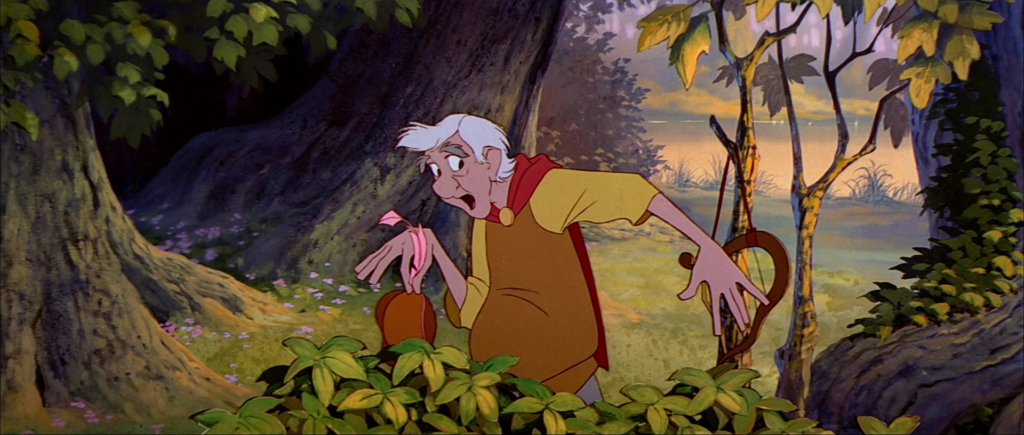
Fflewddur’s characteristic exclamation from the books (“Great Belin!”) makes it into the movie.[5]Belin is a god from Welsh mythology. But he’s not a quarter as funny or endearing as he is in the text. Well, OK, maybe he’s a quarter as funny and endearing. Hawthorne’s vocal performance is one of the better ones in the movie and there’s one really funny moment where he covers his harp’s magical strings with his hand right before they explode from his bluster.
As Taran and Eilonwy however, Bardsley and Sheridan give two of the worst vocal performances I have ever heard in a Disney movie. Some of their line readings are flat and some of them are overdramatic. Were these really the best actors who auditioned for the roles? But to be fair, neither of them is given much help by the bland, boring writing. I know that the serious characters in animated Disney movies, such as the various fairy tales princes, are generally regarded as boring. But most of those movies don’t focus much on the serious characters. (Snow White and the Seven Dwarfs focuses more on the dwarfs, Cinderella more on the mice, Sleeping Beauty more on the fairies, etc.) The Black Cauldron, on the other hand, really wants to be about Taran’s character arc and his relationships with the other characters and those things were very compelling in the original books. But the versions in this movie are horribly dull.
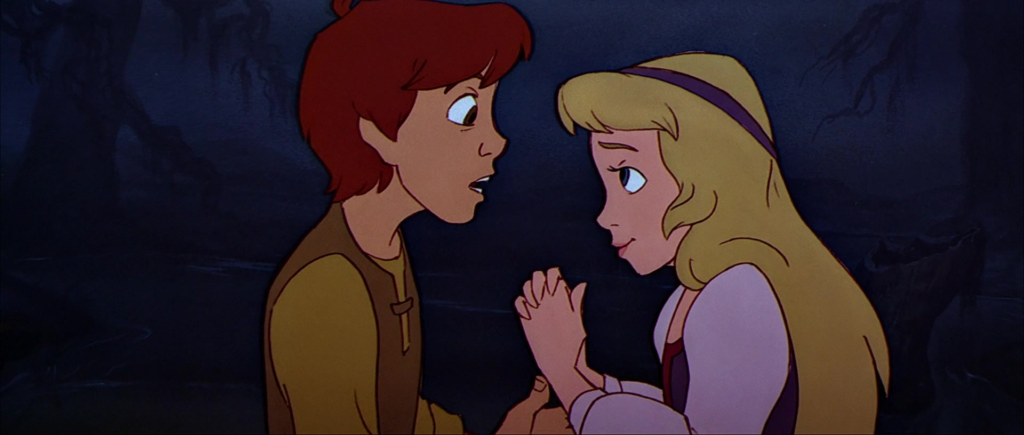
Speaking of animated Disney movies, I believe this was the first one not to be some sort of musical. I’ve gone on record as saying that I don’t believe kids demand musical numbers from all their entertainment as some seem to think but it recently occurred to me that The Black Cauldron might actually have benefited from being a musical. Assuming the songs were good, which is admittedly a bit of a gamble, Taran singing about wanting to be a hero at the beginning would likely be much more engaging than him just talking about it to no one in particular. He mostly just comes across as whiny.[6]Imagine if in Disney’s Beauty and the Beast, Belle just walked around her yard, complaining about how boring her town was, instead of singing about it. True, Taran is supposed to start out as whiny and grow into a better person, but a song with eloquent lyrics and a memorable tune would do more to make us sympathize with him even in his whininess.
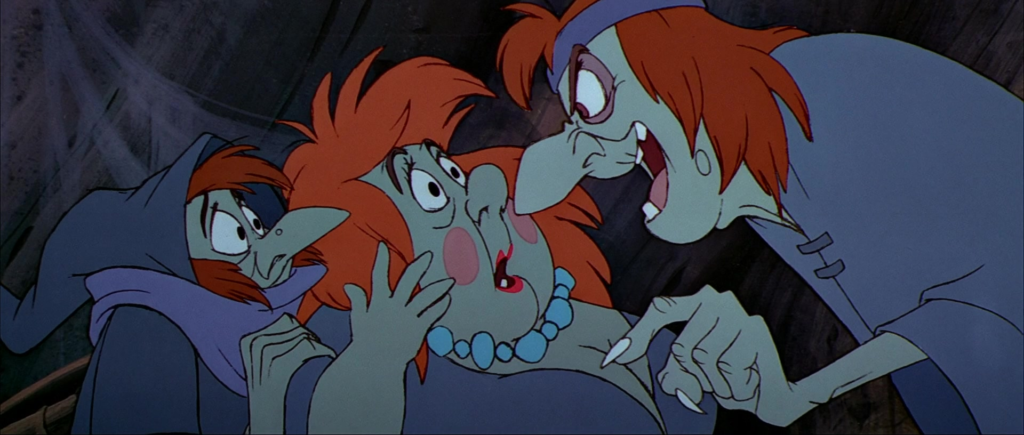
Other characters are similarly true to the broad outlines of their literary counterparts without capturing their charm. Dalben is as critical of Taran’s immaturity as he is in the books but not nearly as insightful or witty. The three witches of Morva more or less keep the dynamic they had in the books with Orwen (Adele Malis-Morey) being more girlish, Orgoch (Billie Hayes) being more evil[7]The witches claim to be more amoral than immoral in the books but Orgoch certainly comes close. and Ordu (Eda Reiss Marin) being the most levelheaded and the trio’s spokeswoman. But they’re simply not very funny.
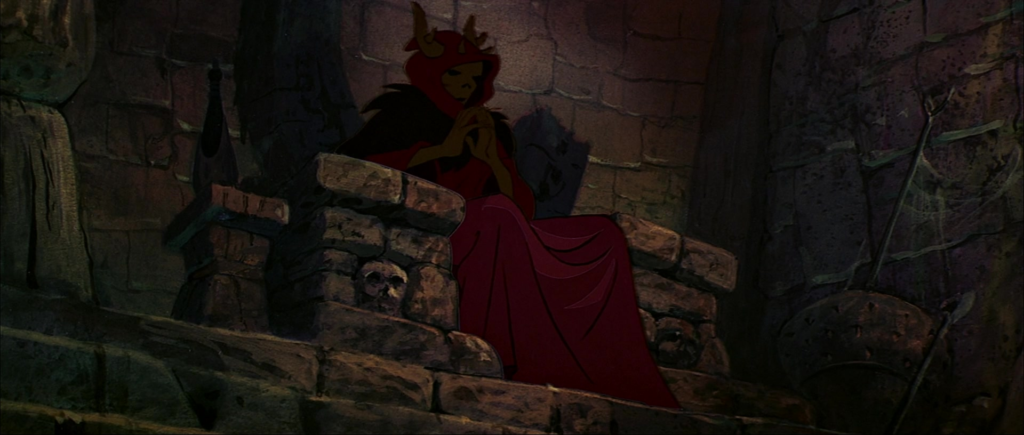
Ironically, the best character in the movie is the one who’s technically the most changed from the book. The Horned King is a combination of various antagonists from The Chronicles of Prydain, but he makes for a great villain. John Hurt’s vocal performance is easily the best in the film and even when he’s not speaking, the Horned King is a chilling presence. The Black Cauldron becomes infinitely more gripping whenever he’s onscreen.
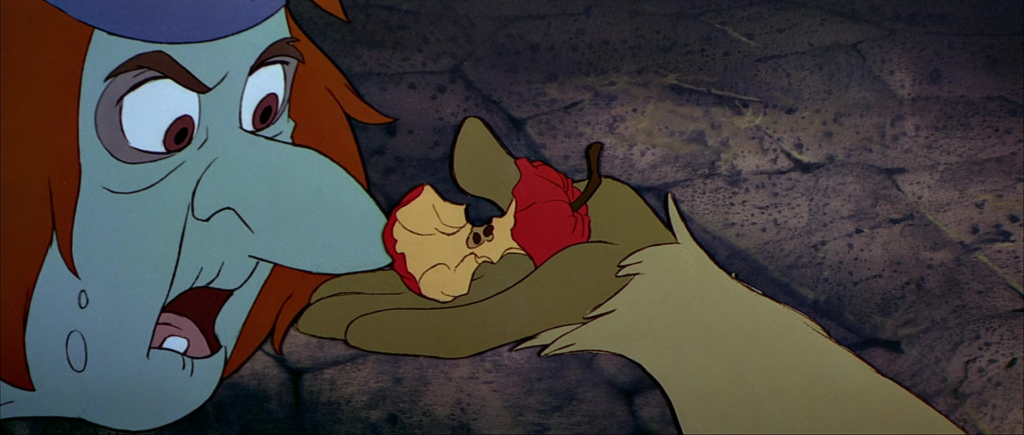
The adaptation’s other problems are generally more what you’d expect: the results of squashing the first two books in a series into one story. There are a lot of gestures towards a larger mythology that never get explained. How exactly is Eilonwy a princess? What’s with her golden bauble? How did Taran end up living with Dalben? Those and other questions are answered by the books, but the movie raises questions of its own that it doesn’t answer. For example, Taran refers to a war in his first scene, but we never learn any more about that. There’s no explanation for the black cauldron’s behavior in the story’s climax beyond the movie wanting an action-packed finale and needing a way to dispose of the villain.[8]I don’t think it’s spoiling anything to reveal that the villain of a children’s movie dies. Because Gurgi doesn’t have his magical wallet of never-ending food, he doesn’t have anything besides an apple core in the scene where all the heroes offer to sacrifice their most prized possession for the cauldron, weakening the dramatic moment.[9]Eilonwy still has her bauble, but she doesn’t offer it in the movie. What’s up with that?
All of Taran’s mentors besides Dalben are cut. To be fair, none of them were the most fun characters and I can see why you’d want to cut them if you absolutely had to turn the first two Prydain books into an eighty-minute movie but the result is that Taran is given no role models in humble heroism, weakening his arc.[10]It’s also kind of weird that he’s called an assistant pig keeper when he seems to be the only pig keeper. The worst omission is that of Prince Ellidyr, one of the most memorable characters from the literary Black Cauldron. Without him, neither Taran’s heroic sacrifice nor the resolution are anywhere near as interesting. On the plus side, if the first two Prydain stories absolutely had to be melded into one and none of the others adapted, giving the sword Dyrnwyn the role of Adaon’s broach makes sense.
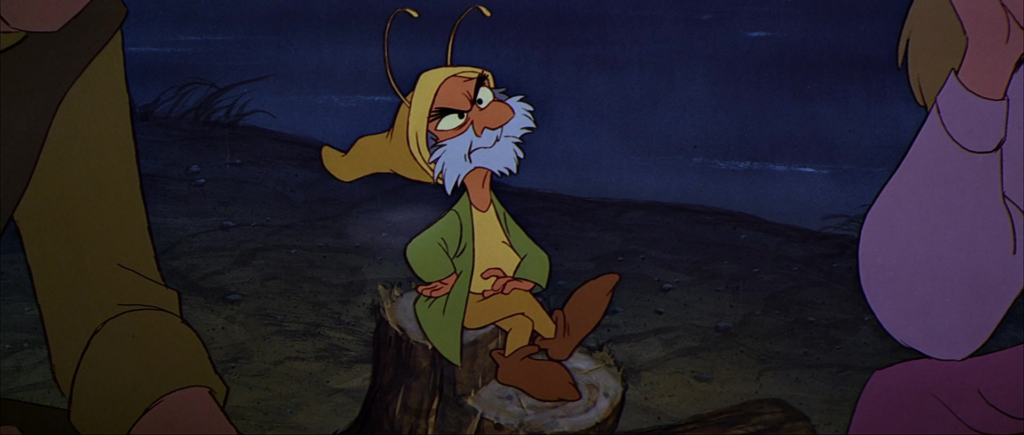
A character whom the adaptation really does dirty is Doli (also John Byner) of the Fair Folk.[11]The Fair Folk in general are some of the least faithfully adapted characters in the movie, being much cutesier and friendlier to humans than in the books. Lloyd Alexander’s version was definitely a prickly curmudgeon, but he never abandoned the heroes as he does in the movie. He was separated from them in the book The Black Cauldron, but he returned in the end to rescue them. The film gives that role to Gurgi. It doesn’t seem to want Doli to be unsympathetic though as its final moments show him inexplicably watching the heroes with approval. Would it have killed the filmmakers to have him actually do something to redeem himself?
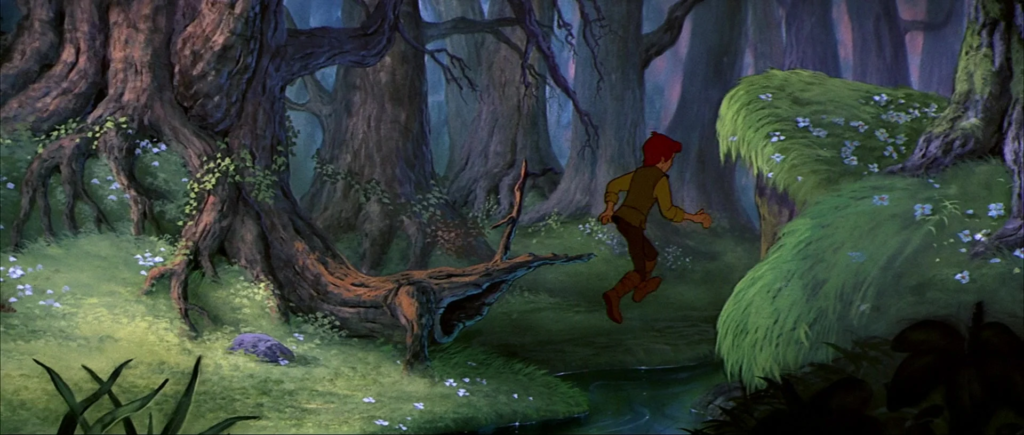
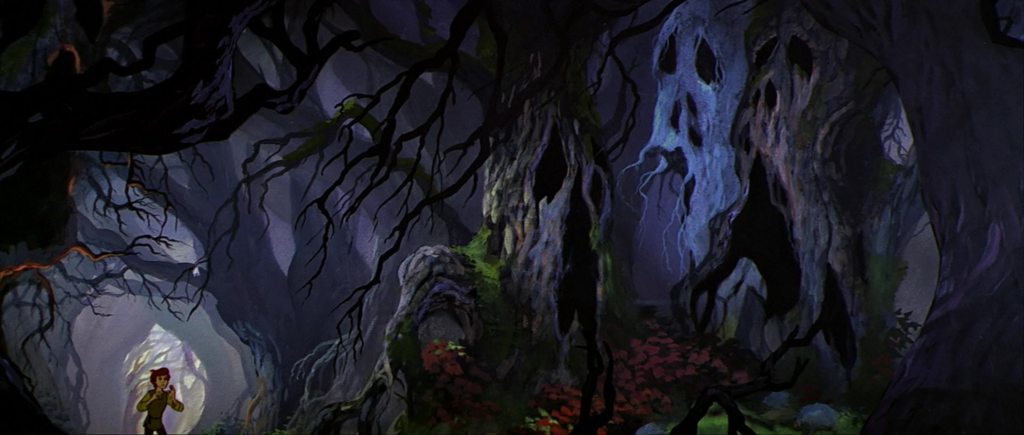
I’m probably making the movie sound unwatchably bad which it really isn’t. There just aren’t many reasons to watch it. Some of the action scenes are enjoyably suspenseful. The music by Elmer Bernstein has its good moments though much of it is too cacophonous for my taste.[12]There’s also a weird moment when after an effectively ominous prologue (narrated by John Huston) explaining the cauldron’s evil, we cut to the movie’s title and the score suddenly … Continue reading The backgrounds are fine though I’m mystified that some critics praise the film’s visuals even if they criticize its story.
For a while, The Black Cauldron was described as Disney’s worst animated movie[13]As in their worst movie to be animated, not the movie with the worst animation., from its main animation studio anyway. I haven’t watched every one of their animated movies and neither do I intend to do so, so I can’t speak with authority, but I still feel like that’s fair. There are other Disney cartoons with more annoying aspects, but this one is the most lifeless and dull of any of them.[14]I did end up seeing the recent Wish which many on the internet were denouncing as a trainwreck-largely for good reasons in my opinion. But while The Black Cauldron‘s basic premise is much … Continue reading It’s a shambling zombie of a Disney movie.
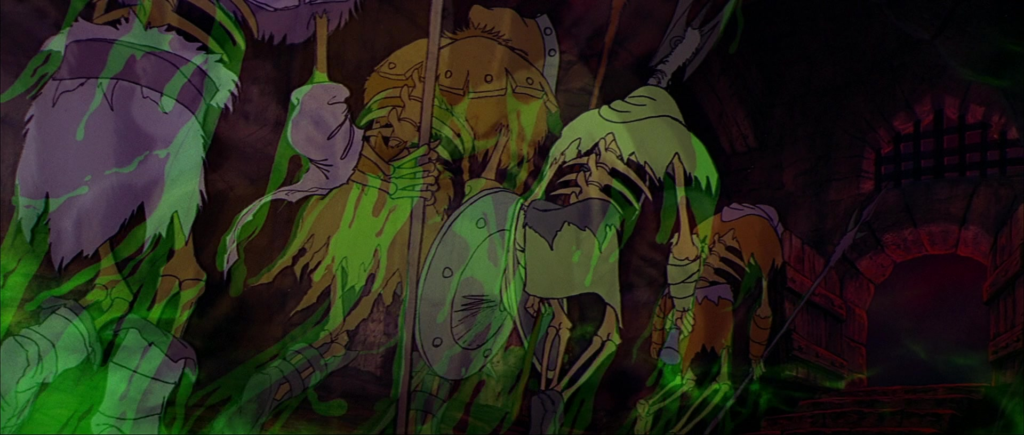
One of the only things about it with a little flair is the character animation and even that’s largely misguided flair. The characters are prone to flailing around and making constant sweeping gestures which are easier for animators but distracting to watch. This movie also has some of the unfunniest slapstick to appear in an animated Disney film.
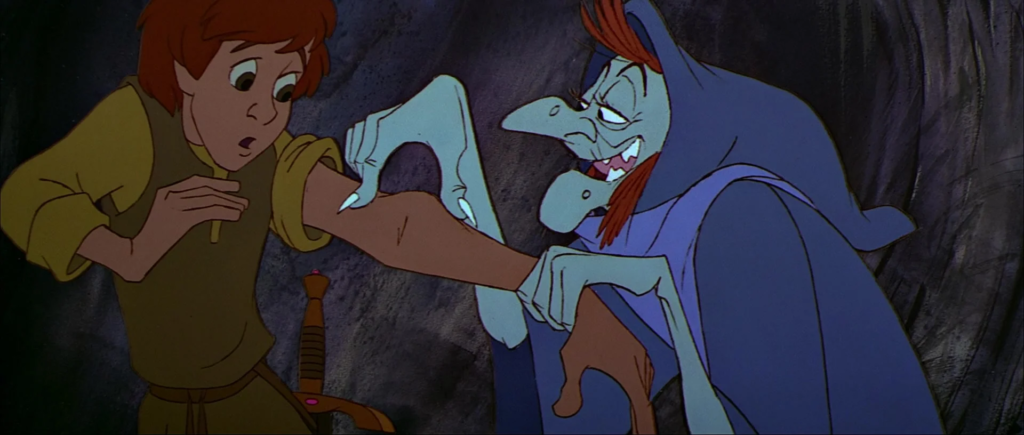
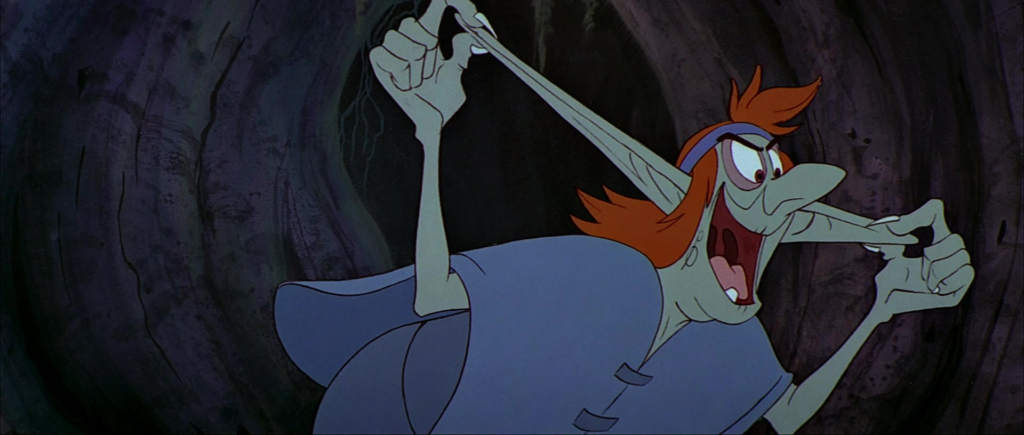
Fans of the Prydain books have long lamented that this is the only noteworthy adaptation of them out there and rightfully so. Hopefully, someone will give it another shot someday.
References
| ↑1 | The title of the first of which is The Book of Three by the way. |
|---|---|
| ↑2 | Sorry about all these unpronounceable names. Welsh, you know? |
| ↑3 | Well, she’s a bit less unflappable than in the books but I’m willing to believe that’s because the action scenes wouldn’t work as well if she didn’t display any fear. |
| ↑4 | This movie had so many writers, I’m not going to bother mentioning all their names. |
| ↑5 | Belin is a god from Welsh mythology. |
| ↑6 | Imagine if in Disney’s Beauty and the Beast, Belle just walked around her yard, complaining about how boring her town was, instead of singing about it. |
| ↑7 | The witches claim to be more amoral than immoral in the books but Orgoch certainly comes close. |
| ↑8 | I don’t think it’s spoiling anything to reveal that the villain of a children’s movie dies. |
| ↑9 | Eilonwy still has her bauble, but she doesn’t offer it in the movie. What’s up with that? |
| ↑10 | It’s also kind of weird that he’s called an assistant pig keeper when he seems to be the only pig keeper. |
| ↑11 | The Fair Folk in general are some of the least faithfully adapted characters in the movie, being much cutesier and friendlier to humans than in the books. |
| ↑12 | There’s also a weird moment when after an effectively ominous prologue (narrated by John Huston) explaining the cauldron’s evil, we cut to the movie’s title and the score suddenly turns from being ominous to strangely celebratory. |
| ↑13 | As in their worst movie to be animated, not the movie with the worst animation. |
| ↑14 | I did end up seeing the recent Wish which many on the internet were denouncing as a trainwreck-largely for good reasons in my opinion. But while The Black Cauldron‘s basic premise is much better than Wish‘s confusing and unrelatable one, Wish at least has a consistently strong voice cast and a little pizzazz. |