“You’re thinking about something, my dear, and that makes you forget to talk. I can’t tell you just now what the moral of that is, but I shall remember it in a bit.”
“Perhaps it hasn’t one,” Alice ventured to remark.
“Tut, tut, child!” said the Duchess. “Everything’s got a moral, if only you can find it.” Lewis Carroll, Alice’s Adventures in Wonderland
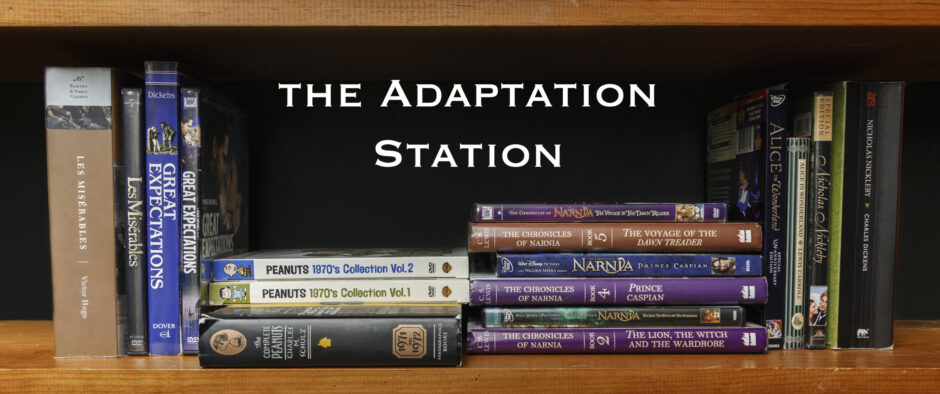
Looking back on my blog, I see that I’ve written about nearly all the things I’ve included in the header image I made for it years ago. Les Misérables. Great Expectations. Peanuts (specifically from the 1970s.) The Chronicles of Narnia. Nicholas Nickleby. The only ones I haven’t done are Lewis Carroll’s Alice books. No time like the present to fix that. But for once, I’m not going to write about the adaptation that I included in the photo. That’s not a slight against the 1951 animated Disney movie. I love it. But, growing up, I loved the 1999 made-for-TV movie from Hallmark entertainment even more, mainly because it was longer and included more from the books.[1]A YouTube video essay about the Disney film argues that it has a special appeal for children on the Spectrum. I think that may explain my childhood affinity for Alice. It’s also probably more … Continue reading

Upon rewatching however, I must admit that the 1951 Alice in Wonderland has the virtue of brevity whereas the second half of the 1999 movie can drag somewhat, at least if you’ve already watched it once and know where it’s going. Perhaps the filmmakers should have just settled for adapting Alice’s Adventures in Wonderland and cut the three episodes taken from Through the Looking Glass and What Alice Found There. But they’re so great, I can’t bear to imagine that possibility.[2]The movie might have been even longer. According to an interview with the director, they filmed the White Knight’s song from Through the Looking Glass, A-Sitting on the Gate, but it had to be … Continue reading
Actually, this Alice takes many cues from the Disney movie. It mostly adapts Alice’s Adventures while including a few scenes from Through the Looking Glass and it emphasizes bright colors, big name stars, surreal visual humor and musical numbers. There are even a few moments that might be homages to the Disney movie, such as the Caterpillar (Ben Kingsley) turning into a butterfly or Tweedledum (Robbie Coltrane) and Tweedledee (George Wendt) blocking Alice (a pre-Napoleon Dynamite Tina Majorino)’s way as she tries to get away from them. Fans of the books who dislike that adaptation, probably won’t like this one either. But, as I mentioned, I love both. If fan criticism of them is coming from the perspective that Alice’s Adventures in Wonderland is a Serious, Intellectual Work of Literature, I’d like to remind people that it began as a story the author randomly made up to entertain three kids on a summer outing. A colorful and commercial adaptation makes sense to me.
Anyway, this movie has a great script, courtesy of playwright Peter Barnes who also wrote Hallmark Entertainment’s excellent 1999 Christmas Carol movie starring Patrick Stewart and their masterful 2000 Arabian Nights miniseries. Even when this Alice in Wonderland‘s dialogue isn’t taken from Lewis Carroll it’s clever and quotable. (When explaining to Alice how his lectures divide people, the Mouse (Ken Dodd) tells her, “Last time, the whole audience hissed. Hissed! All except one man. He was applauding the hissing.”) The film is also full of actors who feel like they’re having fun with their roles and are fun to watch in them.[3]Martin Short is admittedly a bit annoying as the Mad Hatter but, hey, the character is meant to be annoying. Mind you, the characters aren’t all exactly as Lewis Carroll depicted them. For example, the Caterpillar, or Major Caterpillar as he’s called here, is much more verbose and argumentative than in the book but Ben Kingsley’s performance is so much fun that I don’t really care.

The Mock Turtle (Gene Wilder) is also much less perpetually morose in this version. His foil, the Gryphon (voiced by Donald Sinden) has likewise been changed from a cheery cockney to a more dignified upper-class character. I’m willing to allow that since they get two of the movie’s best songs, The Lobster Quadrille and Beautiful Soup, neither of which would be as much fun if the Mock Turtle were moaning and sobbing as he sang them.

Speaking of music, one of the best things about the movie is its soundtrack by Richard Hartley.[4]He also composed the music for the 2012 Great Expectations. You wouldn’t necessarily expect an Alice in Wonderland adaptation to have beautiful music as opposed to fun music. But “beautiful” is exactly the word to describe this film’s score.[5]Which isn’t to say the songs aren’t fun too. It actually makes the White Knight (Christoper Lloyd)’s farewell to Alice a genuinely moving moment in its goofy way.

For a made-for-TV movie from the 90s, this Alice in Wonderland‘s visuals are pretty great. While most adaptations show what Alice shrinking would look like from the outside, this one actually gives you an idea of what it would feel like to, using the book’s metaphor, “shut up like a telescope.”


I love the way Wonderland is constantly shifting. When Alice resurfaces after falling into the Pool of Tears, she finds herself swimming in a canal somewhere. Next minute, she’s in a giant library[6]Actually, the library is probably normal sized. She’s just tiny at the moment. where she opens a giant pop-up book revealing a giant pop-up of a house. As Alice walks toward the house, it becomes a real house and she’s in a wood. While none of those transitions come from the Alice books, they are very true to their overall spirit.
Some of the movie’s creatures, like the White Rabbit (voiced by Richard Coombs and physically performed by Kiran Shah, the White Witch’s dwarf in The Lion, the Witch and the Wardrobe (2005.)), look like real animals who just happen to wear clothes. Others, like Bill the Lizard (Paddy Joyce) have costumes and makeup that hint at their animal nature in the theatrical tradition. The Cheshire Cat is an animatronic, courtesy of Jim Henson’s creature shop, with Whoopi Goldberg’s face superimposed on it. Ordinarily, I would prefer a consistent approach to portraying the animals, but the movie’s inconsistency fits with the randomness of Wonderland. I must say though I don’t understand why it was necessary to make the March Hare (Francis Wright) look so ugly.


The main thing this adaptation adds to the story is a message and a character arc for Alice in which she learns to be more courageous. I’d argue that the lack of a moral was something that made the Alice books stand out from other Victorian children’s stories. To give them a point is to miss the point, so to speak. What’s more, I never got the impression from the books that Alice was someone who suffered from timidity. She usually tried to be polite but when confronted with something that really offended her sensibilities, such as crockery being thrown at babies or sentences before verdicts or books without pictures, she never hesitated to speak out against them. However, the 1999 movie isn’t the only adaptation to portray Alice this way. Both the 1985 miniseries and the 2010 movie, the latter of which functions as a fanfic-y sequel to the Alice books, also give her an arc where she learns to face her fears. And if you compare how this plays out in each version, it reflects very well on the 1999 Alice.
Interestingly, a party plays a part in each movie too. In 1999, Alice’s parents (Jeremy Brudenell and Janine Eser) are pressuring her into singing for their guests at a garden party but she’s stricken by stage fright. (The justification for this from the books is that Alice spends much of her time trying and failing to correctly recite poetry and the other characters spend much of their time reciting poetry to her whether or not she wishes to hear it.) She runs to the woods where she encounters the White Rabbit and follows it down the rabbit hole, etc. In 1985, on the other hand, Alice (Natalie Gregory)’s problem is that she wants to attend her parents’ tea party but isn’t allowed on the grounds that she’s too young. In 2010, a garden party is being held by a wealthy family that’s friends of a nineteen-year-old Alice (Mia Wasikowska)’s. Their nebbish son (Leo Bill) is going to propose to Alice for the sake of her recently widowed mother (Lindsay Duncan), and everyone is pressuring her to accept him. Remember what I wrote about how the Alice in the books never struck me as afraid to stand up for what she believed? Well, the 2010 movie must agree with me on some level since its Alice is written as being a defiant rebel against society right from the start. To the movie’s credit, sometimes she’s an entertaining rebel. (When her would-be mother-in-law (Geraldine James) rhetorically asks if she knows what she (the mother) has always dreaded, Alice replies, “The decline of the aristocracy?”) But this makes it hard to worry there’s any danger of her caving into social pressure when it comes to this prospective marriage. Are we supposed to buy that she’ll refuse to wear stockings just because society says so but will let others make a major life decision like marriage for her?
When the 1985 Alice reads the famous poem Jabberwocky, the monster itself appears and menaces her, only to just as quickly disappear. An Owl (Jack Warden), one of the few characters in the miniseries not to come from the books, tells her that the Jabberwocky was created by her fears[7]If you said that Jabberwocky is the name of the poem and that the monster in it is called a Jabberwock, you remember the poem better than either Paul Zindel, who wrote the 1982 miniseries or Linda … Continue reading and that it’ll keep appearing until she conquers them. Sure enough, the beast keeps popping up throughout her adventures in the Looking Glass World.[8]In the 1999 Alice, the Monstrous Crow from the Tweedledum and Tweedledee episode behaves similarly though it’s less intrusive. At the climax, she yells at it to go away, saying she doesn’t believe in it anymore. It dissolves into smoke and only then does Alice return to the real world. Her mother (Sheila Allen, wife of producer Irwin Allen) inexplicably invites her to have tea with the grownups.[9]Charles Dodgson AKA Lewis Carroll saw childhood, particularly girlhood, as the ideal state, so I’m not sure if he would have approved of all the coming-of-age themes in these adaptations. In the 2010 movie, the Jabberwocky is the tyrannical Red Queen (Helena Bonham Carter)’s main enforcer[10]The Red Queen here is given the Queen of Hearts’s personality, mainly so the White Queen (Anne Hathaway, giving, for my money, the movie’s most entertaining performance) can be her … Continue reading and Alice is the prophesied heroine destined to slay it. Only after she overcomes her misgivings and does so is she able to return home. There she stands up to all the people who intimidated her before.[11]Again, this would be more of a cheer-raising moment if she’d actually come across as intimidated by them before. Instead of marrying into the rich family, she gets a job as an apprentice to their trading company, enabling her to support her mother, and goes on a voyage to China. I feel like this would have been a more triumphant ending if Alice had been established earlier as someone who was eager to explore new worlds. You’d think that’d be easy with her being Alice![12]By the way, in the 1999 movie, the actors who play the Wonderland characters double as guests at the garden party in the real world. It’s possible that the screenwriter intended that to be the … Continue reading


How does Alice gaining confidence play out in the 1999 movie? Well, for most of the runtime, the moral seems rather tacked on with the various characters she encounters in Wonderland simply telling Alice not to be afraid and that the show must go on, etc., things she could have been (and indeed was) told back home.[13]Though the White Knight advising her to always get back on her horse fits perfectly with his character. But it pays off in the climax when Alice is called upon to testify at the trial of the Knave of Hearts (Jason Flemyng) and stands up to the irrational tyranny of the King and Queen of the same (Simon Russell Beale and Miranda Richardson.) (“I can’t let you condemn an innocent man,” she says. “Why not?” asks the King. “It happens all the time.”)[14]The 1985 miniseries also has Alice plead on the Knave’s behalf but she sounds tearful and vulnerable rather than calm and no-nonsense. I don’t necessarily mind that since Alice is often … Continue reading To me, that’s what makes Alice a cool character in the source material. She doesn’t slay monsters but, like the child in the story of The Emperor’s New Clothes, she’s not afraid to call out adults on their nonsense. Her retort when the Queen calls for her head is so great that I wish it were in the book. Alice literally brings the King and Queen’s whole house of cards tumbling down.

The 1999 Alice in Wonderland also has a more satisfying way to have Alice fulfill her familial obligations in the end while still being herself than the 2010 one has. It’s something that actually relates to what she’s experienced in Wonderland rather than something tacked on the end of the story to provide a happy ending. When Alice…But I’ve already spoiled too much. Suffice it to say, I love this movie.
References
| ↑1 | A YouTube video essay about the Disney film argues that it has a special appeal for children on the Spectrum. I think that may explain my childhood affinity for Alice. It’s also probably more interesting than this blog post. |
|---|---|
| ↑2 | The movie might have been even longer. According to an interview with the director, they filmed the White Knight’s song from Through the Looking Glass, A-Sitting on the Gate, but it had to be cut for time. I’d love to hear that which tells something about the film’s quality when I just said it feels overlong. |
| ↑3 | Martin Short is admittedly a bit annoying as the Mad Hatter but, hey, the character is meant to be annoying. |
| ↑4 | He also composed the music for the 2012 Great Expectations. |
| ↑5 | Which isn’t to say the songs aren’t fun too. |
| ↑6 | Actually, the library is probably normal sized. She’s just tiny at the moment. |
| ↑7 | If you said that Jabberwocky is the name of the poem and that the monster in it is called a Jabberwock, you remember the poem better than either Paul Zindel, who wrote the 1982 miniseries or Linda Woolverton who wrote the 2010 film. |
| ↑8 | In the 1999 Alice, the Monstrous Crow from the Tweedledum and Tweedledee episode behaves similarly though it’s less intrusive. |
| ↑9 | Charles Dodgson AKA Lewis Carroll saw childhood, particularly girlhood, as the ideal state, so I’m not sure if he would have approved of all the coming-of-age themes in these adaptations. |
| ↑10 | The Red Queen here is given the Queen of Hearts’s personality, mainly so the White Queen (Anne Hathaway, giving, for my money, the movie’s most entertaining performance) can be her benevolent counterpart. But her character design still has a heart motif despite her never being called the Queen of Hearts and her soldiers look more like playing cards than chessmen. This is not confusing at all. |
| ↑11 | Again, this would be more of a cheer-raising moment if she’d actually come across as intimidated by them before. |
| ↑12 | By the way, in the 1999 movie, the actors who play the Wonderland characters double as guests at the garden party in the real world. It’s possible that the screenwriter intended that to be the case in the 2010 movie too since some of the characters parallel each other, most notably the Red Queen and the potential mother-in-law. But if that was the intention, director Tim Burton evidently didn’t get the memo and none of the actors double. |
| ↑13 | Though the White Knight advising her to always get back on her horse fits perfectly with his character. |
| ↑14 | The 1985 miniseries also has Alice plead on the Knave’s behalf but she sounds tearful and vulnerable rather than calm and no-nonsense. I don’t necessarily mind that since Alice is often tearful and vulnerable in the books, but it doesn’t really show her becoming more mature and, to be fair, the miniseries doesn’t pretend it does. |