I never wanted this to be a Disney blog. I mean, I always wanted to do some blog posts about Disney movies since I’m a fan of fairy tales and classic children’s fantasies, many of which they’ve adapted, and I consider animation to be a fascinating medium. But it seemed to me that there were enough blogs about Disney movies and Disney-related things in general. I’d rather have more posts about my more niche interests. But I don’t have that many ideas for blog posts about those interests right now. This summer, The Adaptation Station.com is going to be all or mostly about Disney adaptations. I’m really surprised at myself for doing a two-part series on the recent live action(ish) remake of the 1937 animated movie, Snow White and the Seven Dwarfs, especially since the series is going to be less about the remake itself than the Controversy around it. Ordinarily, I disdain writing about things just because they’re controversial.[1]I do try, within reason, to mention whether there’s anything in whatever piece of entertainment I cover that might offend anyone, but the blog isn’t really about that. I don’t even watch or read things just because they’re controversial! And Snow White (2025) seems like the kind of controversial movie that makes for the most boring blog posts since, in my opinion, it’s neither good enough to deserve defending nor bad enough to deserve more attacks than it’s already had. But now that I’ve finally watched the film, I do find it to be interesting in that it’s the kind of controversial movie you wouldn’t guess would be controversial from simply watching. The controversy only makes sense knowing the context, as opposed to the content, of this Snow White.
The main readers of this blog are my friends and family, and I assume most, if not all, of them weren’t that interested in all the controversy, so I should probably sum it up for them. Honestly though, Snow White had such a cursed production history that it’s hard to know where to start. Not only have the actors who were in it, like Gal Gadot sparked controversy, but even actors who weren’t, like Peter Dinklage and Warwick Davis, have done so.[2]I was going to explain in this footnote but after writing the rest of this post, I don’t have the energy. Sorry. You’ll just have to use Google. This blog series is mainly going to be about the gender-related controversy though, so that’s what I’ll explain. Infamously, in early interviews, the movie’s star, Rachel Zegler, dismissed the 1937 movie as hopelessly dated, saying she never enjoyed it even as a child, and calling the love interest in it a stalker. She praised her version for not being a love story but rather about a girl realizing her leadership potential. While Zegler referred to the movie’s male lead as a “great dude,” she also said (jokingly?) that all his character’s scenes could easily be cut. “It’s Hollywood, Baby!” Naturally, this turned off fans of the animated movie, especially conservative ones. Zegler being vocally pro-choice, anti-Israel, anti-Trump, etc. didn’t do much to reconcile the latter to her. The movie went through several reshoots and rewrites[3]Though the only screenwriter to receive credit in the movie itself was Erin Cressida Wilson. which I imagine were at least partially in response to the backlash.[4]I don’t care enough about it to research all the details. In the end, the movie didn’t appeal to conservatives or liberals, not enough for them to go see it in cinemas anyway. It was a notorious box office bomb and left bad blood between Zegler and Disney as well as between Zegler and the general populace.
The remake’s failure was regarded by conservatives as a triumph of “basedness” over “wokery.” I really feel like I should be celebrating it too. Not only do I consider myself a conservative with whom I’m sure Rachel Zegler would never get along, but I’ve been a fan of old-school fairy tales for most of my life. My favorite recent Disney remake is Cinderella (2015) which was actually accused of being antifeminist by some leftwing critics and praised for its old-fashioned heroine by some rightwing critics. I’m also a big fan of Charles Dickens books, the heroines of which tend to be condemned as bad depictions of women even more strongly than traditional fairy tale princesses. And I’m also a big fan of the Narnia books, which have also been historically criticized for their portrayal of women. If you’d predicted the Snow White controversy to me ten years ago, I’d have disbelieved you but wholeheartedly wished it would come to pass. The prospect of Hollywood being pressured into treating old-school heroines with the respect I believe they deserve instead of always having to radically reimagine gives me great satisfaction.
Yet somehow, I can’t rejoice as much as some conservatives are doing. Maybe it’s because I have a foot in both camps. While I’ve grown up loving traditional fairy tales and still love them today, I also grew up loving some modern fairy tales that were feminist adjacent at least, such as the works of Gail Carson Levine. And while the 2015 Cinderella is my favorite piece of modern Disney nostalgia bait, my second favorite is the 2019 Aladdin which took an explicitly feminist approach to its heroine.[5]Mind you, I don’t think the movie actually gave modern feminists what they want since it basically shoehorned a feminist heroine into a male-driven story. For the record, I’d say that … Continue reading As for animated Disney princesses, I don’t hate Snow White with a passion but I’m more of a fan of Belle and Mulan though I hasten to add I’m more of a fan of the animated Cinderella than I am of many more feminist-friendly Disney princesses.[6]Truth be told, I gravitate towards the animated Disney films from the 1950s. Their heroines (Cinderella, Alice, Wendy Darling, Lady, Flora, Fauna and Merryweather) tended to be traditionally polite … Continue reading I think the real reason I’m writing this blog series is that there’s this weird dissonance between the way conservatives tend to describe Snow White (2025) and the movie I actually saw when I finally got around to watching it. For the record, if you’re a conservative who boycotts Disney (or, for that matter, a progressive who boycotts them), I’m not saying you should abandon your principles and watch this film. I’m just saying conservatives who cite this as the most insufferably progressive thing the company has made strike me as silly.[7]For one thing, this Disney movie doesn’t have any token gay or trans characters. I try to remind myself that plenty of conservative reviewers who castigated the movie went into it with open minds (or tried to keep their minds open anyway) and would have been the first to admit if they were pleasantly surprised. But so much of the vitriol aimed at this Snow White seems so out of proportion to me and the criticisms so nitpicky that I can’t help thinking that many hoped for it to be as bad as possible.[8]Along similar but apolitical lines, many fans of the animated movie, who weren’t particularly conservative, regarded it as sacred and objected to the very idea of a remake. I respect that as … Continue reading To be fair though, I’d pegged the film as middling and broadly left-coded but largely harmless long before I watched it, so I could also be accused of confirmation bias. To come to your own conclusions, keep reading.
How Is the Movie Just as a Movie?
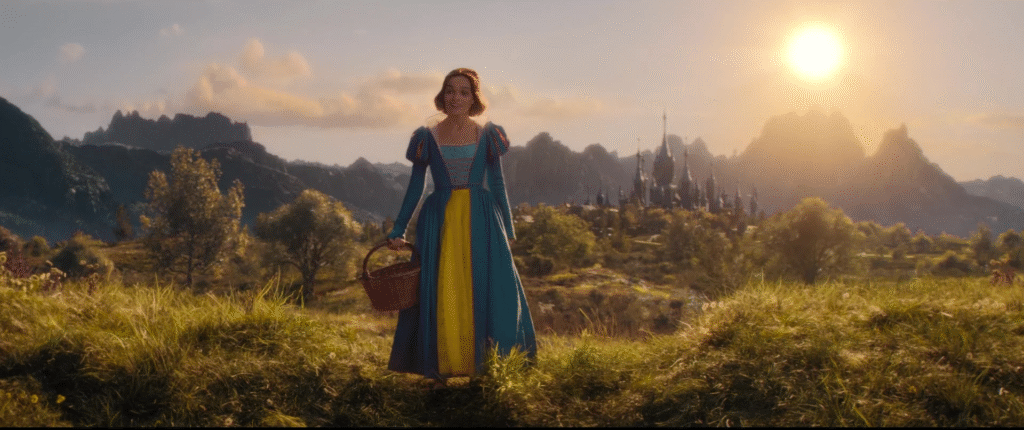
It seems like anyone who calls any modern Disney movie better than utter garbage gets dubbed a shill. There’s probably no way I can escape that, but I’ll try by starting with all the things about Snow White (2025) that I consider bad, beginning with the visuals. The costumes are much more concerned with reminding people of the 1937 classic than they are with actually looking good on the actors. When Snow White appeared in white for the final scene, my mom, who was watching with me, said, “They finally got her out of that dumb dress!”[9]Interestingly, Sandy Powell the costume designer also designed the costumes for Cinderella (2015) which I feel had the best costumes of any recent Disney fairy tale even if the colors were a little … Continue reading
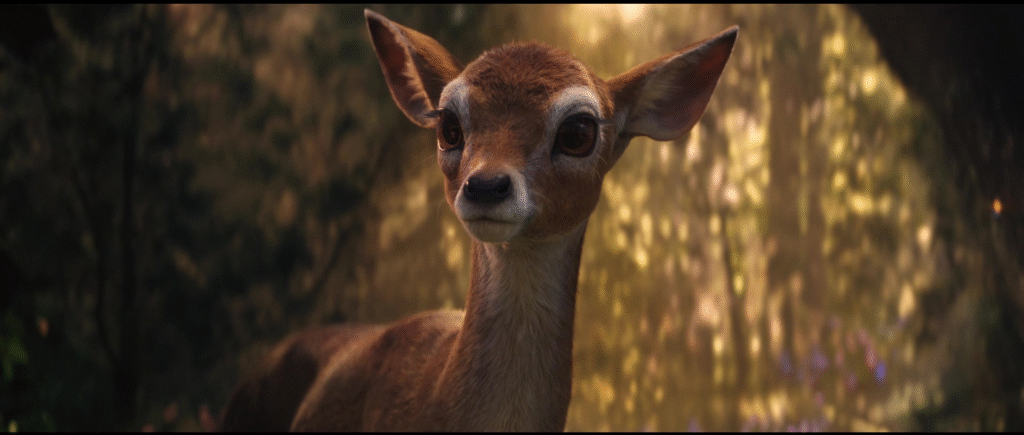
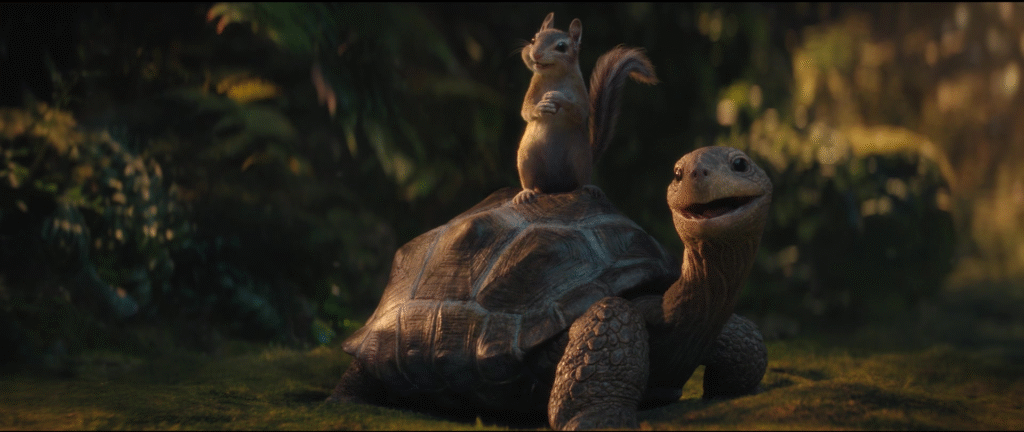
The giant eyes of the CG forest animals are supposed to look cute but to my eyes, they just look kind of creepy.[10]I recall the cricket and the goldfish from Disney’s Pinocchio remake looking that way too. Whatever issues Beauty and the Beast (2017) had, at least the filmmakers realized that certain cartoon … Continue reading
The seven CG dwarfs also look pretty freaky, humans being one of the hardest things to do in computer animation.
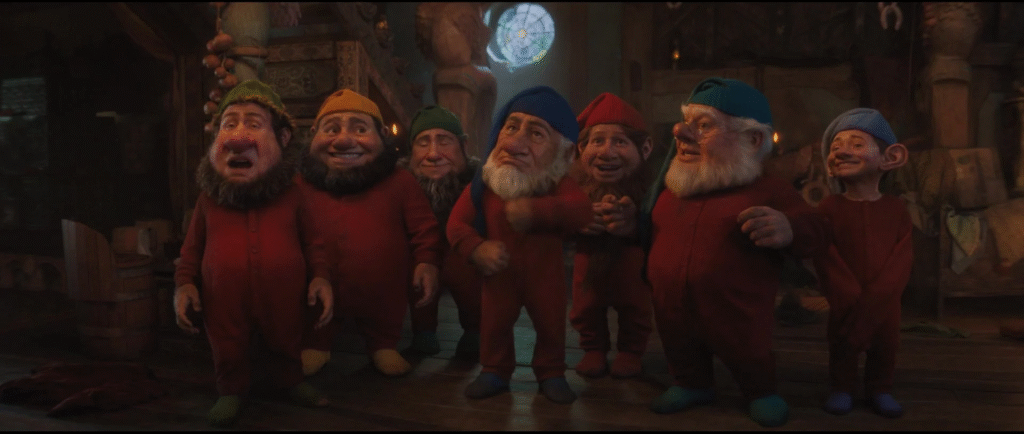
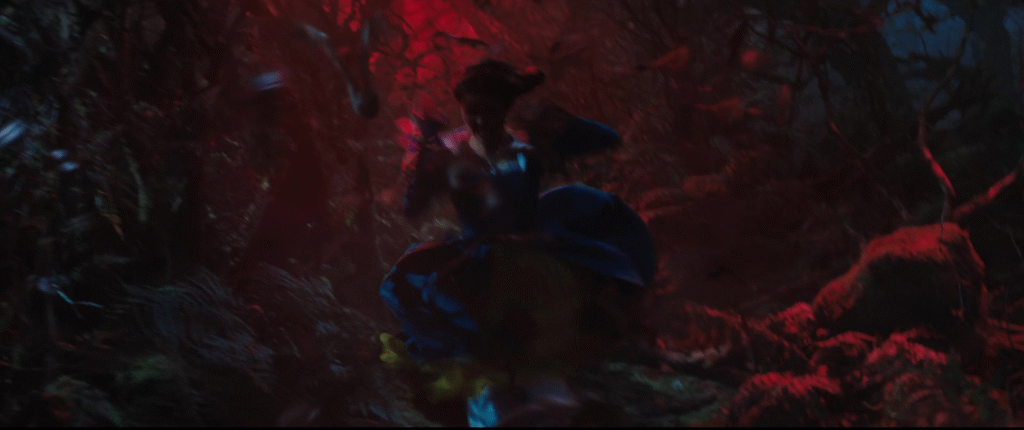
What’s more, the comedy of the dwarfs and the forest animals isn’t half as funny as that of their 1937 counterparts. The scenes of Snow White’s nightmarish run through the forest and the queen transforming herself into an ugly old crone also lack the emotional punch that had in the old movie. (I’m not sure if the filmmakers were even trying in the last case.)
The decision to include some of the 30s-style showtunes by Leigh Harline, Frank Churchill[11]No relation to the character from Emma. and Paul Smith from the original movie along with modern-style songs by Benj Pasek, Justin Paul and Jack Feldman was pretty ridiculous.[12]Cinderella (2015) wisely decided not to be a musical and only had the heroine briefly sing a snatch of one of the 1950 movie’s songs as an easter egg for fans as well as having two others in … Continue reading The movie tries to make them blend together by adding sassy new lyrics to the old songs, but this just feels wrong. (At one point in the updated Whistle While You Work, Grumpy (voiced by Martin Klebba) threatens to shove Bashful (Titus Burgess)’s scrub brush “where the sun don’t shine.”) I’ve enjoyed some of Pasek and Paul’s work in the past (their other musical credits include Dear Evan Hansen, La La Land and The Greatest Showman) but, even taking them on their own terms and ignoring the songs from the 1937 film, their songs here are all pretty forgettable with one exception to which I’ll get to presently. There’s an annoying plot point where the huntsman (Ansu Kabia) says to Snow White before she runs off that “she was never told the truth about her father” but doesn’t bother saying what the truth was. (It’s pretty easy to guess but, of course, nobody does until the queen spells it out for Snow White.) The climax is even more ridiculous. (I’ll get into it in the spoiler-filled parts of this series.)
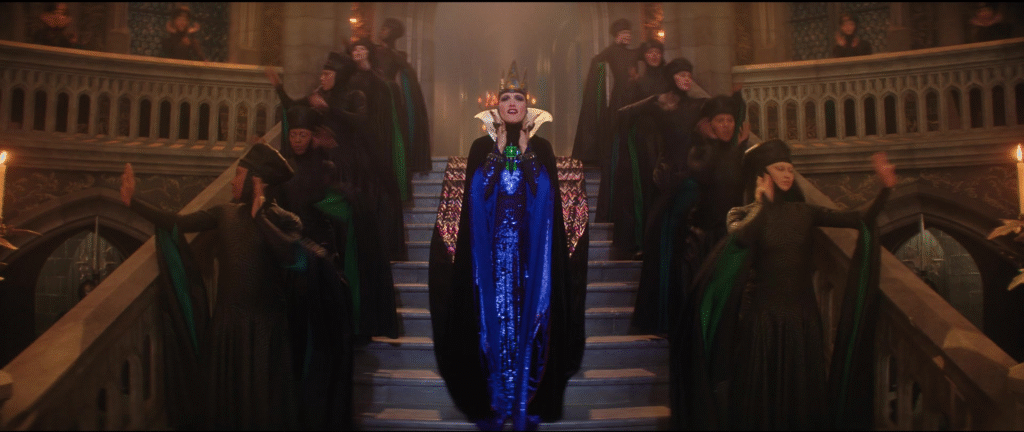
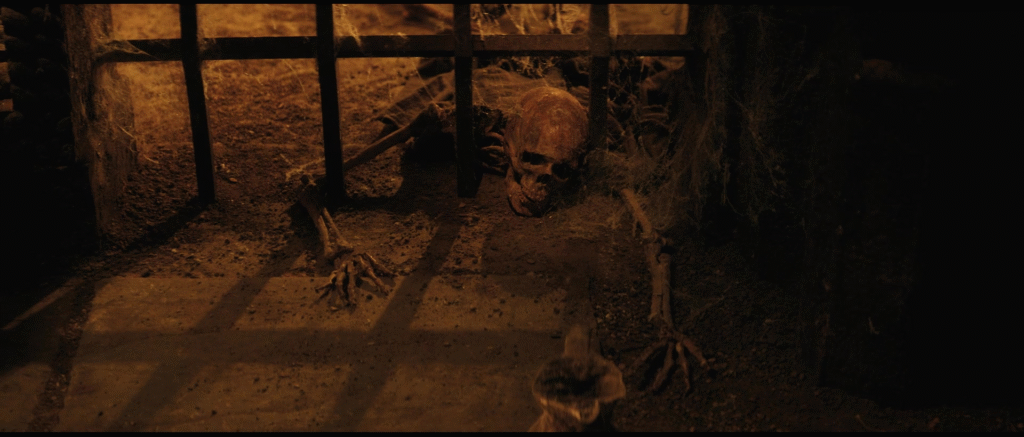
Having said all that, however unlikeable you or I might consider Rachel Zegler herself, she’s very appealing as Snow White and has a lovely singing voice. Gal Gadot is great fun as the cartoonishly evil queen. I also honestly enjoyed some of the movie’s attempts at foreshadowing, heavy handed as they are, such as Snow White describing the queen as poisoning people’s minds long before she literally poisons her or singing about being wakened by a kiss long before that happens. The song in which she does the last one, A Hand Meets a Hand, is the one from the movie that I really like. While I described the movie as less funny than the original animated one, there are some scattered funny bits. And while I also described the scary scenes as less effective, I’m kind of impressed the remake kept the grisly detail of the skeletons in the queen’s dungeon though she doesn’t kick or taunt one of them here.
The writing in general isn’t terrible or anything, just rather bland and generically modern. And apart from the annoying plot points I mentioned above, I think the reimagined story is pretty good. I can imagine it making for a good fairy tale movie with better direction and writing. As the film is, if you enjoy the genre and are bored, it’s not an unpleasant diversion.
So that’s the not-related-to-politics part. Not very interesting, was it? Now I’ll address some common criticisms I’ve heard of the 2025 Snow White online from a specifically conservative perspective. Major Spoilers Ahoy!
Common Conservative Criticism 1: The Story is Socialist Propaganda for Kids
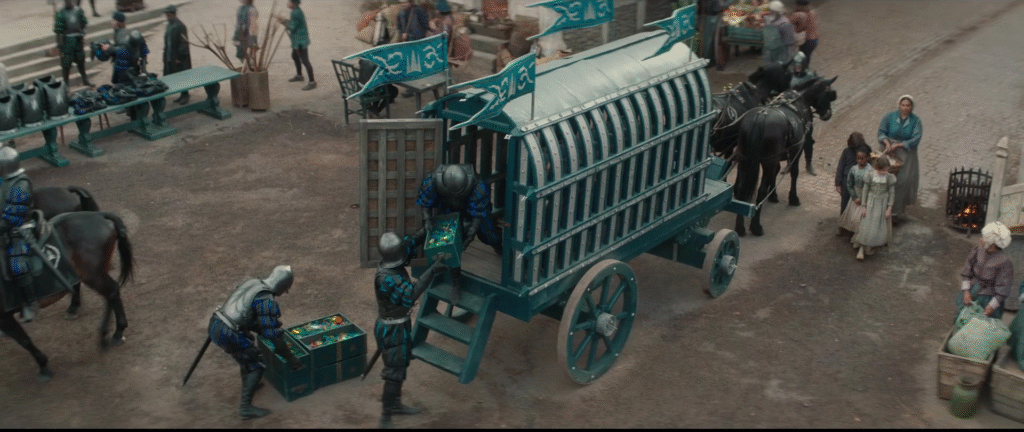
The movie begins with the narrator (Andrew Barth Feldman) informing us that Snow White was brought up to believe that “the bounty of the land belonged to all who tended it.” Along similar lines, the soundtrack version of the opening song includes the lyrics, “we lead with open hearts, and we live with open doors.”[13]These were cut from the movie itself. A first glance would seem to justify the accusation of socialist messaging, not to mention accusations of corny writing.[14]Of course, it’s not like the animated Snow White and the Seven Dwarfs wasn’t corny in its own way. Given Hollywood’s social milieu, I’ve no doubt these parts do reflect such political leanings but giving the movie more than a first glance reveals that if it’s socialist propaganda, it’s the most capitalist-friendly socialist propaganda ever.
The queen’s tyrannical rule doesn’t involve introducing a system of free markets to the kingdom. While the script is somewhat vague about the details, the implication is that she forcibly seizes all of her subjects’ property for herself-exactly what conservative Americans fear a socialist government would do. Either that or it’s a case of taxation without representation, another thing they’re against. On the other hand, the queen doesn’t redistribute the wealth to everyone, as socialists would advocate, but hoards it all for herself. She strikes me as a villain whom both capitalists and socialists can hate. In the end, Snow White doesn’t convince the populace to turn against the queen by saying how nice it was when they didn’t own anything. She reminds them of how great it was when they owned things themselves and freely chose to share them with others. In my experience, when American conservatives are asked who will help the poor if they don’t have the government aid, their answer is privately owned charities. That also seems to be what Snow White advocates. Contrary to caricatures of conservatives by liberals, they don’t teach their children not to share with each other. But by ranting against this movie’s message of sharing, they run the risk of looking like caricatures of themselves. In her big musical number, the queen proclaims that she can do whatever she wants, singing, “all is fair when you wear the crown.” From what I understand, American liberals are talking about “rule of law” right now, but it wasn’t so long ago when conservatives were the ones worrying about it. The leftwing filmmakers may not have realized it, but their message transcends party lines-or if you want to be a cynical, you could say it’s a message with which whichever party isn’t in power can agree. Likewise, while the fact that the climax involves Snow White, more or less, leading a protest against the queen reflects our culture these days, it’s not like conservatives never partake in protests. It’s also worth noting that Snow White’s rallying speech looks back to the past rather than forward to the future. That doesn’t seem very progressive-coded. (My best guess is it represents the leftwing writers’ nostalgia for Barack Obama’s presidency.)
I imagine the movie listing the queen drafting men into an army as an example of her wickedness and her later telling people Snow White shouldn’t be queen because she can’t keep them safe or raise any army were intended to be some sort of Take That at Donald Trump. (Although if Gal Gadot is supposed to be doing a parody of him, she didn’t do a very good job.) It’s pretty dumb to suggest that a country can do without an army and that any leader who cares about them is evil. But does anyone really expect political realism from a movie like this? I think all it merits is an eye roll.
CCC 2: The Remake Turns the Character of Snow White Into an Insufferable Girl Boss
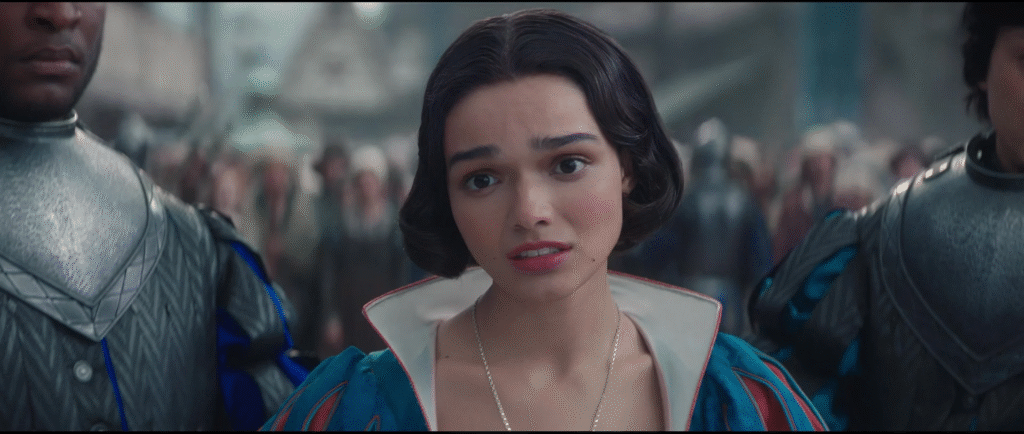
It’s true that whereas the first song we heard the 1937 Snow White sing was about her “wishing for the one (she) loved to find (her),” this Snow White sings in the equivalent moment about wishing to be “someone no one needs to save.” Later, she sings that it’s time for her “to lead and not be led.” Her main goal throughout the story is to overthrow her stepmother and become queen herself. However, I’m confused as to why this particular reimagining has drawn such ire for doing the same thing that ABC’s Once Upon a Time, Tarsem Singh’s Mirror Mirror and Rupert Sanders’s Snow White and the Huntsman did with the character.[15]Along similar lines, while Rachel Zegler’s derogatory comments about the animated Snow White and the Seven Dwarfs didn’t endear her to me, they weren’t really anything new to me … Continue reading I suppose it’s because this Snow White is specifically a remake of the iconic Disney movie and not just another adaptation of the Grimm fairy tale-though pretty much every Snow White adaptation these days is really based more on that movie than the fairy tale. What stands out to me about this remake is not how it makes Snow White more of a feminist-friendly heroine. That’s to be expected. What strikes me is how, compared to other recent adaptations of the story, this one tries to retain the animated character’s sweet, motherly personality.
Snow White’s kindness is emphasized from the very first scene where we see her as a child (played by Emilia Faucher) give her crown of flowers to a shy, sad girl (Freya Mitchell.)[16]Later in the movie (when the girl is grown up and played by Zoe Athena), the crown actually becomes a nice visual symbol. While her goal is to become queen, her motivation is a desire to help the suffering people of the kingdom rather than to gain power for herself. When she meets the seven dwarfs, she’s able to remember all their names like the ideal hostess, a skill which serves her will in the movie’s climax. She comforts and encourages Dopey after he’s humiliated in front of the others and she wins over Grumpy by being the only one to acknowledge when he has a good point. These all seem like traditional feminine virtues to me. If this is the most obnoxious girl boss Disney has created recently, they’re doing better than I thought.
Snow White’s initial timidity and lack of confidence aren’t portrayed as the result of “the patriarchy” but of the emotional abuse of a villainous matriarch who dismisses her as beautiful but weak, useless and fragile. “Your subjects await you, Snow White,” sneers the queen, “What will you tell them? That you’ve made them dessert?” In the end though, her stepdaughter’s sweetness and compassion are her strengths. If anything, it makes sense to interpret the movie as an antifeminist fable with the wicked “girl boss” being defeated by a heroine who represents traditional femininity.[17]Of course, many feminists these days say the problem with society isn’t that women aren’t allowed to act like men, but that society is governed by a stereotypically masculine mindset and … Continue reading
The dumbest part of the movie, if you ask me, isn’t the result of making Snow White more of a leader or a fighter but by making sure she conquers the queen in a way consistent with her 1937 counterpart’s character. In their final confrontation, the queen gives Snow White a knife and dares her to kill her in front of everyone. She refuses which her stepmother naturally takes as evidence that she’s weak. Then Snow White gives a speech reminding the guards of how much happier they and everyone else were before the queen was in power. Seemingly, the whole army joins her. It’s so stupid when kids’ movies resolve problems by having a character give a speech and all the relevant characters just agree with them![18]Sadly, it’s not entirely confined to kids’ movies. Has any conflict in real life ever been resolved that way? Having Snow White defeat the queen with violence would have been a more boringly conventional ending for a girl empowerment film but it would also have made more sense.[19]In the original fairy tales by the Brothers Grimm, Snow White (or, rather, her husband, but it’s implied she’s complicit) forces the queen to dance to death in red hot iron shoes. Now … Continue reading Still, there is a hint of an interesting thematic idea here that could have resonated with both liberals and conservatives for different reasons if it had been handled better.
I find it odd that people who can’t stand this movie’s version of Snow White seem fine with Princess Leia. In the original Star Wars, doesn’t she complain about how her male rescuers didn’t plan the rescue very well and constantly snark at them? Yet Snow White, who graciously thanks her male rescuers even when they’re grumpy, is the shrew? Of course, Leia isn’t exactly what feminists want in a heroine either since in spite of herself, she eventually ends up succumbing to the advances of a roguish man. Maybe that’s why it’s OK for conservatives to like her story. But I can’t help but suspect it’s because they first saw Star Wars when they were kids wanting to enjoy a movie and they saw Snow White (2025) when they were adults looking for another chance to complain about modern cinema.
At this point, you might think what I’ve described as this remake’s blandness is the result of it trying to cater to viewers on both the left and the right instead of committing to just one. But I find myself thinking nostalgically of the days when a politically middle-of-the-road family popcorn movie like Star Wars could be enjoyed by both liberals and conservatives. I know the obvious rejoinder to that is “movies back then were better written” and I can’t argue in this case.[20]I don’t consider Star Wars the pinnacle of screenwriting or anything, but Princess Leia’s putdowns were pretty snappy. Still, people these days, not only on the right but on the left, seem so impossible to please that I can’t help but imagine they only love older movies because they saw them in their youth.
To Be Continued
References
| ↑1 | I do try, within reason, to mention whether there’s anything in whatever piece of entertainment I cover that might offend anyone, but the blog isn’t really about that. |
|---|---|
| ↑2 | I was going to explain in this footnote but after writing the rest of this post, I don’t have the energy. Sorry. You’ll just have to use Google. |
| ↑3 | Though the only screenwriter to receive credit in the movie itself was Erin Cressida Wilson. |
| ↑4 | I don’t care enough about it to research all the details. |
| ↑5 | Mind you, I don’t think the movie actually gave modern feminists what they want since it basically shoehorned a feminist heroine into a male-driven story. For the record, I’d say that description applies to the animated Aladdin too. |
| ↑6 | Truth be told, I gravitate towards the animated Disney films from the 1950s. Their heroines (Cinderella, Alice, Wendy Darling, Lady, Flora, Fauna and Merryweather) tended to be traditionally polite and ladylike but didn’t hesitate to get angry at anything they really believed was wrong. |
| ↑7 | For one thing, this Disney movie doesn’t have any token gay or trans characters. |
| ↑8 | Along similar but apolitical lines, many fans of the animated movie, who weren’t particularly conservative, regarded it as sacred and objected to the very idea of a remake. I respect that as their position, but I don’t see why I should care about their criticisms of something they were never going to like. |
| ↑9 | Interestingly, Sandy Powell the costume designer also designed the costumes for Cinderella (2015) which I feel had the best costumes of any recent Disney fairy tale even if the colors were a little bright for my taste. Chris Weitz, who wrote Cinderella‘s screenplay, was apparently also one of the uncredited writers for Snow White. You know, I could do a whole blog post about how Snow White tries to do the same thing as Cinderella but doesn’t do them nearly as well. Actually, I think blog series will be about that but mostly in the footnotes. |
| ↑10 | I recall the cricket and the goldfish from Disney’s Pinocchio remake looking that way too. Whatever issues Beauty and the Beast (2017) had, at least the filmmakers realized that certain cartoon characters needed to be redesigned for photorealism. |
| ↑11 | No relation to the character from Emma. |
| ↑12 | Cinderella (2015) wisely decided not to be a musical and only had the heroine briefly sing a snatch of one of the 1950 movie’s songs as an easter egg for fans as well as having two others in the end credits after the obligatory pop song. |
| ↑13 | These were cut from the movie itself. |
| ↑14 | Of course, it’s not like the animated Snow White and the Seven Dwarfs wasn’t corny in its own way. |
| ↑15 | Along similar lines, while Rachel Zegler’s derogatory comments about the animated Snow White and the Seven Dwarfs didn’t endear her to me, they weren’t really anything new to me either. Countless modern literary takes on fairy tales, such as The Practical Princess and Other Liberating Fairy Tales by Jay Williams, The Enchanted Forest Chronicles by Patricia C. Wrede and The Ordinary Princess by M. M. Kaye, have displayed the same attitude of “traditional fairy tale princesses are dumb; our princesses know what’s up!” (A nice thing about Gail Carson Levine is that while that may be her opinion, she seldom, if ever, displays it in her books themselves.) I guess the people who were so offended by Zegler just watch movies and don’t read books. |
| ↑16 | Later in the movie (when the girl is grown up and played by Zoe Athena), the crown actually becomes a nice visual symbol. |
| ↑17 | Of course, many feminists these days say the problem with society isn’t that women aren’t allowed to act like men, but that society is governed by a stereotypically masculine mindset and that it needs a more feminine one. Presumably, the leftwing filmmakers intended that brand of feminism though I don’t think it’s the brand people expected from what Zegler said. On the flipside, some modern conservatives hold that the problem with society is that it’s governed by a stereotypically feminine mindset and that it needs a more masculine one. Perhaps the conservative criticism of this Snow White comes from that place. |
| ↑18 | Sadly, it’s not entirely confined to kids’ movies. |
| ↑19 | In the original fairy tales by the Brothers Grimm, Snow White (or, rather, her husband, but it’s implied she’s complicit) forces the queen to dance to death in red hot iron shoes. Now there’s a girl boss for you! |
| ↑20 | I don’t consider Star Wars the pinnacle of screenwriting or anything, but Princess Leia’s putdowns were pretty snappy. |