
Are we, as a culture, forgetting that John Silver from Robert Louis Stevenson’s Treasure Island is the bad guy?
Spoilers ahoy! To explain what I mean, I’m going to have the reveal crucial plot points from the original book, Disney’s 1950 movie adaptation, Muppet Treasure Island (1996) and Treasure Planet (2002.) You have been warned. It’s true that in the book, John Silver keeps the other mutineers from killing young hero Jim Hawkins, but this is explicitly so Jim and the other good guys will put in a good word for him if he ever stands trial back in England. When it seems like the treasure will be in his grasp, Jim can tell that “All else had been forgotten” and “he hoped to seize upon the treasure, find and board the Hispaniola under cover of night, cut every honest throat about that island, and sail away as he had at first intended, laden with crimes and riches.” Then when the treasure isn’t in his grasp after all and his crew turns on him, he teams up with Jim again, giving him a pistol, but Jim is less pleased by this than disgusted by Silver’s mercenariness. In the end, John Silver escapes with a portion of the treasure and Jim and his comrades are “pleased to be so cheaply quit of him.” Jim wishes Silver well but in a rather backhanded way.
That formidable seafaring man with one leg has at last gone clean out of my life; but I dare say he met his old Negress[1]Stevenson’s word, not mine., and perhaps still lives in comfort with her and Captain Flint. It is to be hoped so, I suppose, for his chances of comfort in another world are very small.
This blog post is going to look at Disney’s three adaptations of Treasure Island in chronological order to demonstrate how each one makes Silver more genuinely friendly to Jim than the version before until he finally becomes an outright hero. It should be noted that the Disney company isn’t alone in making this character more sympathetic or positive than the original literary John Silver.[2]The 1999 Columbia movie actually ends up making him the hero and Captain Smollett, Dr. Livesey and Squire Trelawney the villains, completely inverting the book’s moral universe. But sticking to Disney adaptations simplifies things and makes for a catchier blog post title.[3]Also, it’s more convenient since I have access to a Disney+ account.
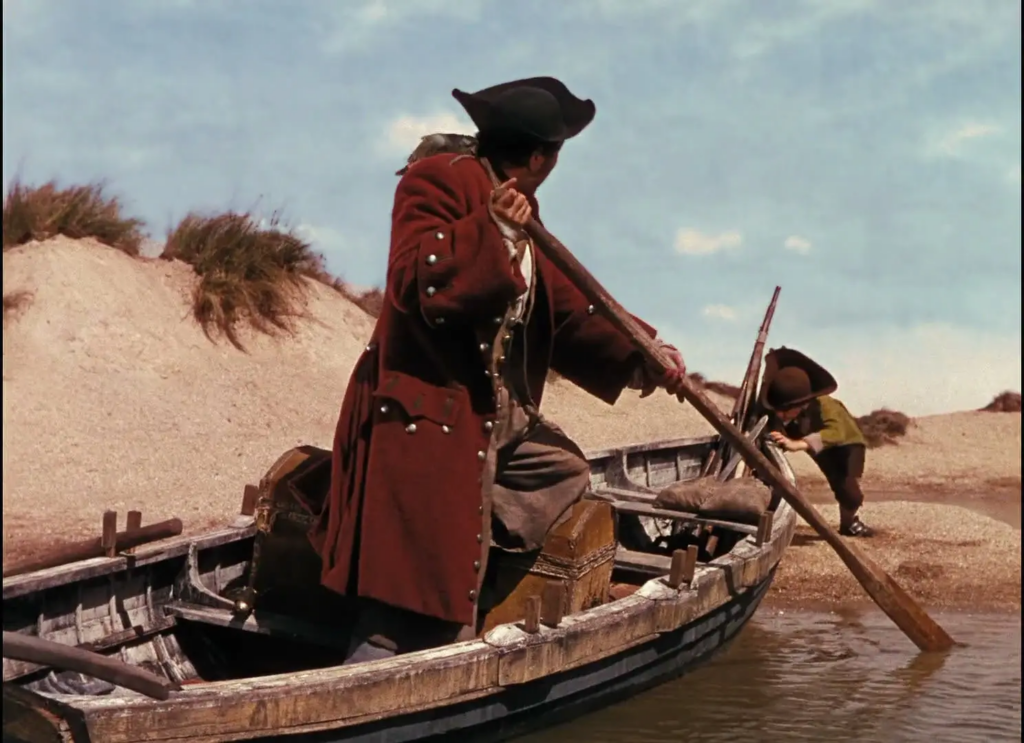
The 1950 live action movie is the one that sticks closest to the original book, which, I suppose, is what you’d hope, it being the only straightforward adaptation Disney has done. No puppets or sci fi or anything. The biggest change it makes is how it depicts Silver’s ultimate escape. In the book, he makes a break for it while most of the heroes are elsewhere. In the movie, he takes Jim Hawkins (Bobby Driscoll) as a prisoner. But when the boy refuses to help him, Silver (Robert Newton) finds he can’t bring himself to kill Jim. Jim, in turn, finds himself unable to see the man, whom he’d once thought of as a friend, struggle helplessly to shove off his longboat and assists him to escape. He feels a bit guilty for this and is relieved to hear Dr. Livesey (Denis O’Dea) say “I could almost find it in my heart to hope (Silver) makes it.”
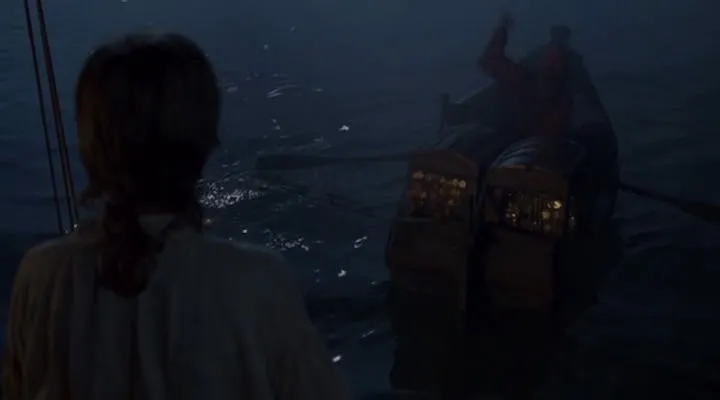
While none of that is from the book, it’s not too big a stretch. Practically every other scene is true to the source material. I suspect the motivation behind the addition was to make the climax of the story more exciting, more than it was to soften Silver’s character and his relationship with Jim. Muppet Treasure Island goes further. In an early scene, when Silver (Tim Curry) learns that Jim (Kevin Bishop)’s father is dead, he seems genuinely sorry for him.[4]In both this movie and Treasure Planet, the absence of Jim’s father hangs heavier over him and the story than it does in the book which dispenses with the father without much fuss. When this Silver’s crew turns on him, he actually tells Jim to make a run for it while he holds them off by himself. “Why are you doing this for me?” asks Jim. “Because I like you, boy,” Silver replies. “I hope you didn’t think I was lying about that.” And that does seem to be the truth. There’s no indication or hardly any, as there is in the book, that Silver is saving Jim for reasons of self-preservation. In a scene similar to the 1950 adaptation’s climax, Silver can’t bring himself to shoot Jim and Jim can’t bring himself to condemn Silver to death by preventing his escape. Moreover, this version of Silver expresses genuine admiration of Jim’s moral qualities, telling him, “You’re honest and brave and true,” adding ruefully, “You didn’t learn that from me.” Earlier, Silver had forced Jim to hand over his late father’s compass, but he returns it to him as a parting gesture of genuine friendliness.
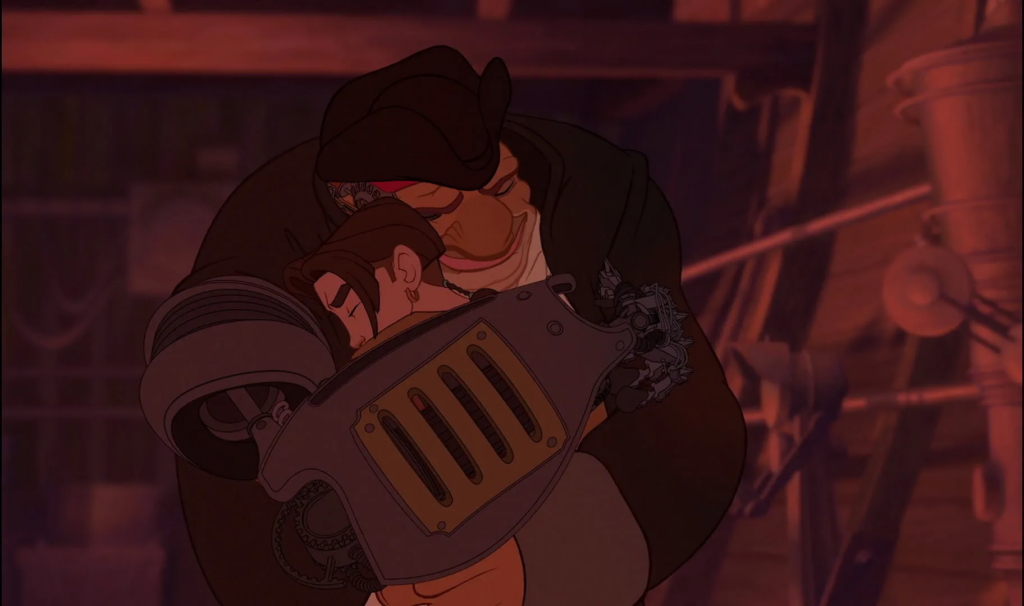
The Disney adaptation that goes furthest in softening John Silver’s villainy is the animated Treasure Planet. I’d argue that this, rather than the science fiction setting, is the biggest change it makes to the story.[5]OK, maybe the second biggest change. Here Silver (voiced by Brian Murray) becomes an outright father figure to Jim Hawkins (Joseph Gordon-Levitt.) When Jim is depressed, wrongly believing he was responsible for the death of Mr. Arrow (Roscoe Lee Browne)[6]Interestingly, in the 1950 Treasure Island, Jim actually was responsible, having given John Silver access to the liquor that he used to get Mr. Arrow (David Davies) drunk., Silver encourages him, assuring him he has “the makings of greatness” in him. Closeups on Silver’s face, when Jim isn’t looking at it, assure us that he’s genuinely motivated by compassion and isn’t just manipulating the boy. Later, a mutineer called Scroop (Michael Wincott), who corresponds to Israel Hands from the book[7]There’s another pirate in the movie who’s actually named Hands, but he doesn’t really have Israel’s role in the story., accuses Silver of having a soft spot for Jim, he claims, “I cozied up to that kid to keep him off our scent.” Jim overhears this and sadly believes it, but the viewers don’t. At the movie’s climax, Silver has to choose between escaping with a boatload of treasure or saving Jim’s life and he chooses the latter. Consequently, Jim allows Silver to escape in the end much more cheerfully than he does in either of the other Disney adaptations. As a parting gift, Silver actually gives him some of the treasure so he can fix up his mother (Laurie Metcalf)’s inn, which Silver and his crew had earlier destroyed in their search for the treasure map.[8]In this version, most of the treasure ends up being destroyed in the climax. See the movie if you want details or check out the Wikipedia synopsis. The movie even ends with Jim warmly reminiscing about the pirate chief, implying that he, rather than the more consistently virtuous captain (Emma Thompson) or doctor (David Hyde Pierce), was his true mentor.
I didn’t write this blog post to bash any of these adaptations.[9]Well, I confess I don’t really like Treasure Planet, but Silver’s character is probably the best thing about it. For me, the comic relief characters are what really don’t work. In a way, the fact that they all try to make John Silver less of a complete villain is a tribute to the character. As with the Artful Dodger of Oliver Twist fame[10]“The Disneyfication of the Artful Dodger” could be its own blog post., adapters enjoy Silver so much that they want him to be something better than he is in the text. After all, the literary Silver may be a monster but he’s also the most charismatic character in the book.[11]Truth be told, he might be the only really memorable character in the book. He’s certainly more competent and admirable than the other villains, a pathetically greedy, superstitious and alcohol-addicted lot. But, as with the Artful Dodger, I fear, especially in an age when more kids have Disney+ subscriptions than will read the book, that we, as a culture, are losing sight of what the made original character memorable in the first place and how much of his charm was meant to be deceptive.
References
| ↑1 | Stevenson’s word, not mine. |
|---|---|
| ↑2 | The 1999 Columbia movie actually ends up making him the hero and Captain Smollett, Dr. Livesey and Squire Trelawney the villains, completely inverting the book’s moral universe. |
| ↑3 | Also, it’s more convenient since I have access to a Disney+ account. |
| ↑4 | In both this movie and Treasure Planet, the absence of Jim’s father hangs heavier over him and the story than it does in the book which dispenses with the father without much fuss. |
| ↑5 | OK, maybe the second biggest change. |
| ↑6 | Interestingly, in the 1950 Treasure Island, Jim actually was responsible, having given John Silver access to the liquor that he used to get Mr. Arrow (David Davies) drunk. |
| ↑7 | There’s another pirate in the movie who’s actually named Hands, but he doesn’t really have Israel’s role in the story. |
| ↑8 | In this version, most of the treasure ends up being destroyed in the climax. See the movie if you want details or check out the Wikipedia synopsis. |
| ↑9 | Well, I confess I don’t really like Treasure Planet, but Silver’s character is probably the best thing about it. For me, the comic relief characters are what really don’t work. |
| ↑10 | “The Disneyfication of the Artful Dodger” could be its own blog post. |
| ↑11 | Truth be told, he might be the only really memorable character in the book. |